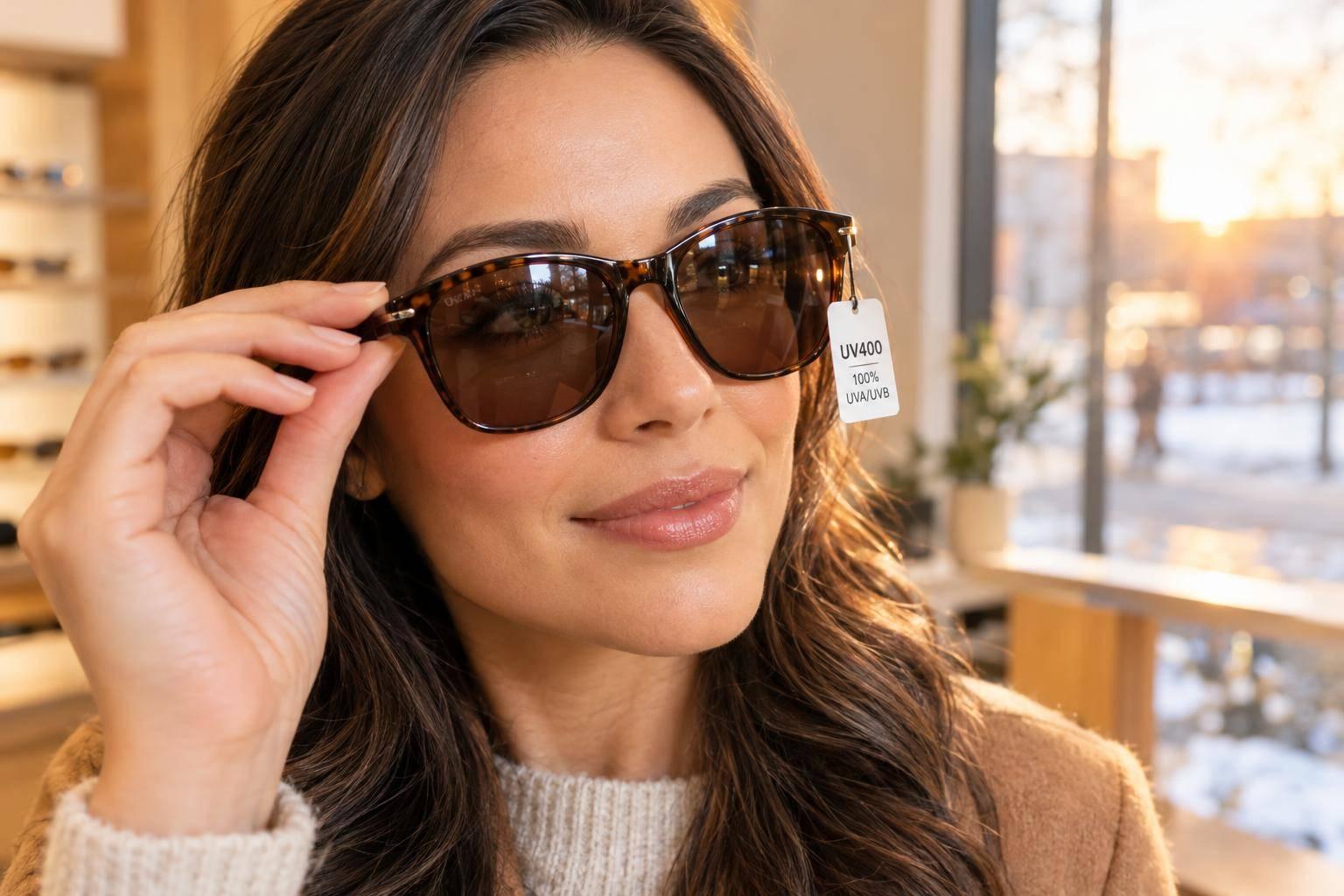
I check for 100% UVA/UVB protection or UV400 before buying sunglasses – not price or lens darkness. UV400-rated lenses block more than 99% of UVA and UVB rays.
Here are four myths I don’t rely on to protect my eyes:
- “Sunglasses are only for sunny days.” Up to 80% of UV rays can pass through clouds.
- “Expensive pairs protect better.” The UV rating matters, not the price.
- “Darker lenses block more UV.” Tint reduces visible light; it doesn’t prove UV protection.
- “UV protection is just for summer or vacations.” Exposure happens year-round, including around reflective snow and water.
My rule: <u>check the UV label first</u>, then choose well-fitting frames and add a hat. Polarized doesn’t mean UV-blocking. If I develop eye pain, light sensitivity, or vision changes after sun exposure, I seek prompt eye care.
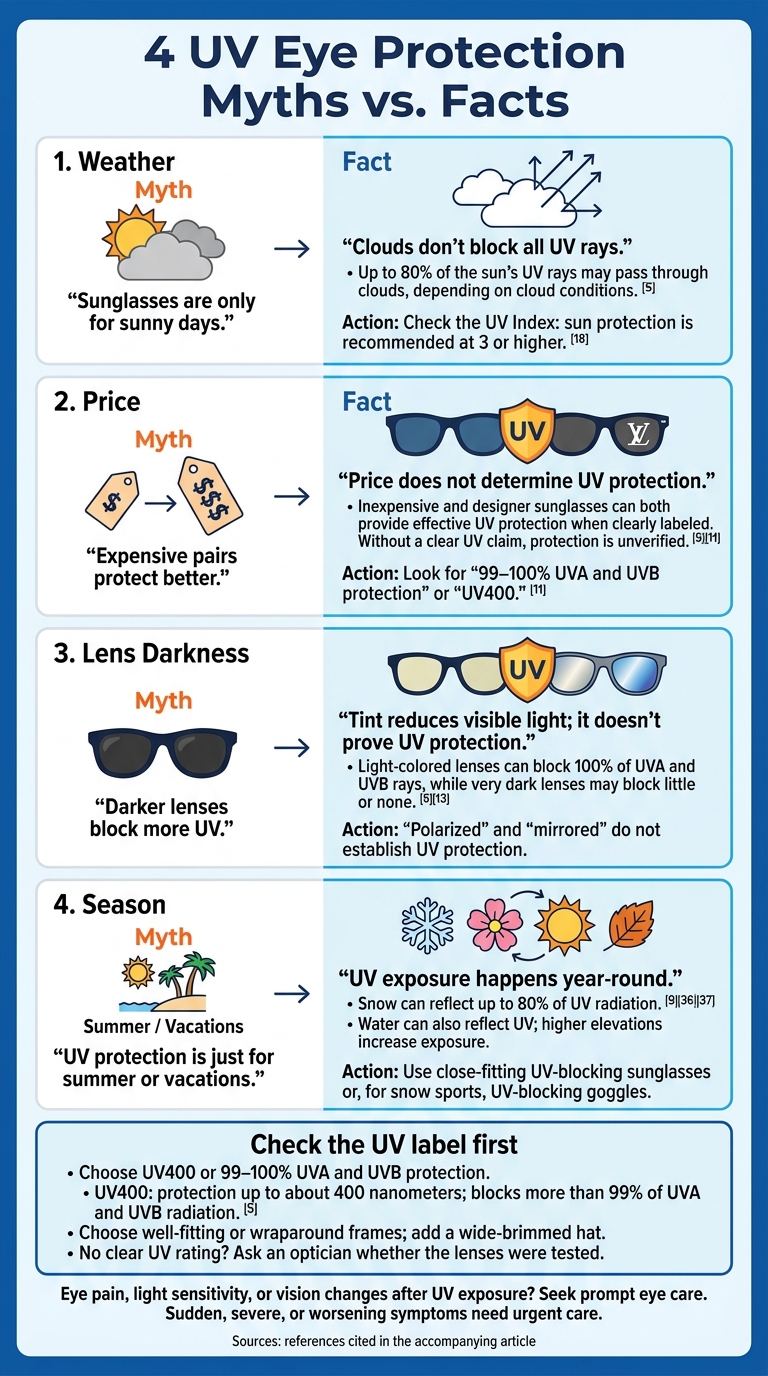
4 UV Eye Protection Myths vs. Facts
UV Exposure and What Sunglasses Labels Mean
UV is invisible. Glare is visible brightness. Visible light is what you see, while glare is intense or reflected light that makes seeing uncomfortable. Tinted lenses can reduce glare, but darker lenses don’t prove UV protection.
High UV exposure can cause photokeratitis, a temporary, sunburn-like injury to the cornea. Symptoms may take hours to appear and include red or watery eyes, a gritty feeling, pain, and light sensitivity. Repeated UV exposure can also contribute to cataracts.
UV400 means protection up to about 400 nanometers. According to the FDA, sunglasses labeled UV400 or 100% UV protection block more than 99% of UVA and UVB radiation.
Look for that rating on the tag, packaging, or manufacturer’s specs. Labels such as “polarized” and “mirrored” don’t establish UV protection. If there’s no UV rating, ask an optician whether the lenses were tested. Eye pain, light sensitivity, or vision changes after intense sun exposure call for prompt eye care.
The first myth to address: sunglasses matter only on sunny days.
sbb-itb-c87b093
1. Myth: You Only Need Sunglasses on Sunny Days
Fact: Clouds don’t block all UV rays. According to the FDA, up to 80% of the sun’s UV rays may pass through clouds, depending on cloud conditions. An overcast sky doesn’t mean your eyes are safe from UV exposure.
Check the UV Index in your weather app before you head out. The CDC recommends sun protection when the UV Index reaches 3 or higher.
Snow, water, and other reflective surfaces can also bounce UV rays into your eyes – even in the shade or under clouds.
Keep sunglasses by the door or in your bag so they’re easy to grab. Choose close-fitting or wraparound frames to help limit UV rays entering from the sides, and wear a wide-brimmed hat for extra coverage. Price, meanwhile, doesn’t determine UV protection.
2. Myth: Only Expensive Sunglasses Block UV
Fact: Price does not determine UV protection. Look at the label, not the price tag. The packaging or product description should state 99–100% UVA and UVB protection or UV400.
Labels such as “polarized,” “sun protection,” and “glare reduction” don’t confirm UV blocking. Skip sunglasses if their UV protection information is missing or unclear.
A higher price may get you better frames, optics, prescription options, or warranties – not better UV filtering.
3. Myth: Darker Lenses Block More UV
Fact: A darker tint doesn’t mean better UV protection. Tint reduces visible light and affects comfort, but it doesn’t tell you how much UV a lens blocks. Light-colored lenses can block 100% of UVA and UVB rays, while very dark lenses may block little or none.
Dark lenses can also widen your pupils. Without UV filtering, that can let more UV reach your eyes.
Check UV protection before choosing a tint. Gray lenses generally keep colors looking natural, while amber lenses may improve contrast outdoors. Neither color is automatically safer. If you’re unsure about a pair’s UV protection, ask an optician to test it.
4. Myth: UV Eye Protection Is Only for Summer and Vacations
Fact: UV exposure adds up all year. Everyday errands, walks, and outdoor sports expose your eyes to UV rays. Over time, repeated exposure can contribute to cataracts and damage the eye’s surface.
Winter has risks, too. Snow can reflect up to 80% of UV radiation, making exposure especially strong. At higher elevations, less atmosphere filters those rays, increasing exposure further. Intense exposure can cause snow blindness, so UV protection belongs in your daily routine – not just your vacation bag.
Keep UV-blocking sunglasses in your coat pocket or bag. For skiing or snowboarding, wear close-fitting UV-blocking goggles to shield your eyes from reflected UV, wind, and cold. Check the local UV Index before spending long stretches outdoors.
Next, let’s look at whether price tells you anything about UV protection.
Compare Sunglasses by Price and UV Protection
Check the UV label before the price tag. The National Eye Institute recommends sunglasses that block 99%–100% of UVA and UVB rays or carry a UV400 rating. A higher price doesn’t mean better UV protection.
Use this table to compare UV labeling – not style or brand.
| Price category | Clear UV label | Takeaway |
|---|---|---|
| Inexpensive sunglasses | “100% UV protection,” “100% UVA and UVB protection,” or “UV400” | Can filter UV effectively without a high price. |
| Expensive or designer sunglasses | The same clear UV claims | You may pay more for materials, fit, or other features, but not necessarily better UV protection. |
| Any price, without a clear UV claim | None on the tag, packaging, or product information | UV protection is unverified. Don’t assume the lenses block UV. |
UV400 means the lenses block UVA and UVB up to 400 nanometers. Dark, tinted, and polarized lenses alone don’t prove UV protection.
Conclusion: Protect Your Eyes Year-Round
Clouds don’t eliminate UV risk. And neither price nor dark lenses prove that sunglasses protect your eyes.
Keep verified UV-blocking sunglasses within reach. Choose frames that fit well and limit exposure from the sides, and add a wide-brimmed hat for extra shade. Make UV protection a daily habit – not just a seasonal one.
If you develop eye pain, strong light sensitivity, or vision changes after UV exposure, see an eye doctor promptly. Sudden, severe, or worsening symptoms need urgent care.
FAQs
Do I need UV eye protection while driving?
Yes, wear UV-blocking eye protection while driving. UV rays can pass through vehicle windows, and sun exposure can contribute to cataracts and other eye damage. Cataracts can cause halos or starbursts around lights, which are especially noticeable when driving at night.
Choose sunglasses labeled UV400 or 100% UVA/UVB protection. These block harmful UV rays rather than just dimming visible light.
Can scratches affect my sunglasses’ UV protection?
Yes, scratches can distort your vision and weaken your sunglasses’ UV protection. Replace damaged lenses right away. Keep your sunglasses clean and in good condition, and store them in a protective case when you’re not wearing them to help them last longer.
Do UV-blocking contacts replace sunglasses?
No. UV-blocking contact lenses don’t replace sunglasses. They block much of the UV radiation, but they protect only the cornea and structures inside your eyes – not your eyelids or the skin around them.
You should still wear sunglasses and a hat outdoors. Boulder Eye Surgeons recommends layering these forms of protection to help shield your eyes and the delicate skin around them from harmful UV exposure.