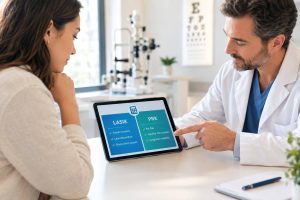
Wavefront-guided LASIK can reduce your need for glasses or contacts, but it cannot promise perfect vision. My starting point: ask whether your prescription has been stable for at least 12 months and whether your corneal scans and tear-film tests support surgery.
Here’s what I’d keep in mind before deciding:
- The treatment: A whole-eye optical map guides corneal reshaping. Wavefront-optimized and topography-guided LASIK use different planning methods.
- The safety checks: Corneal thickness, shape, dry eye, health conditions, and medications can affect whether you qualify.
- The trade-offs: Dryness, glare, halos, and changing vision can occur after surgery. LASIK does not prevent age-related reading problems or cataracts.
- The alternatives: Glasses, contacts, PRK, or lens procedures may fit your eyes better.
- The cost: I’d request a written quote covering testing, surgery, follow-up, and any repeat-treatment policy. Insurance usually does not cover elective LASIK.
My bottom line: <u>start with an eye exam, not a procedure choice</u>. At a Boulder consultation, I’d ask which option fits my eyes, what recovery involves, and what results I can reasonably expect.
Wavefront LASIK
sbb-itb-c87b093
How Wavefront Mapping Guides LASIK
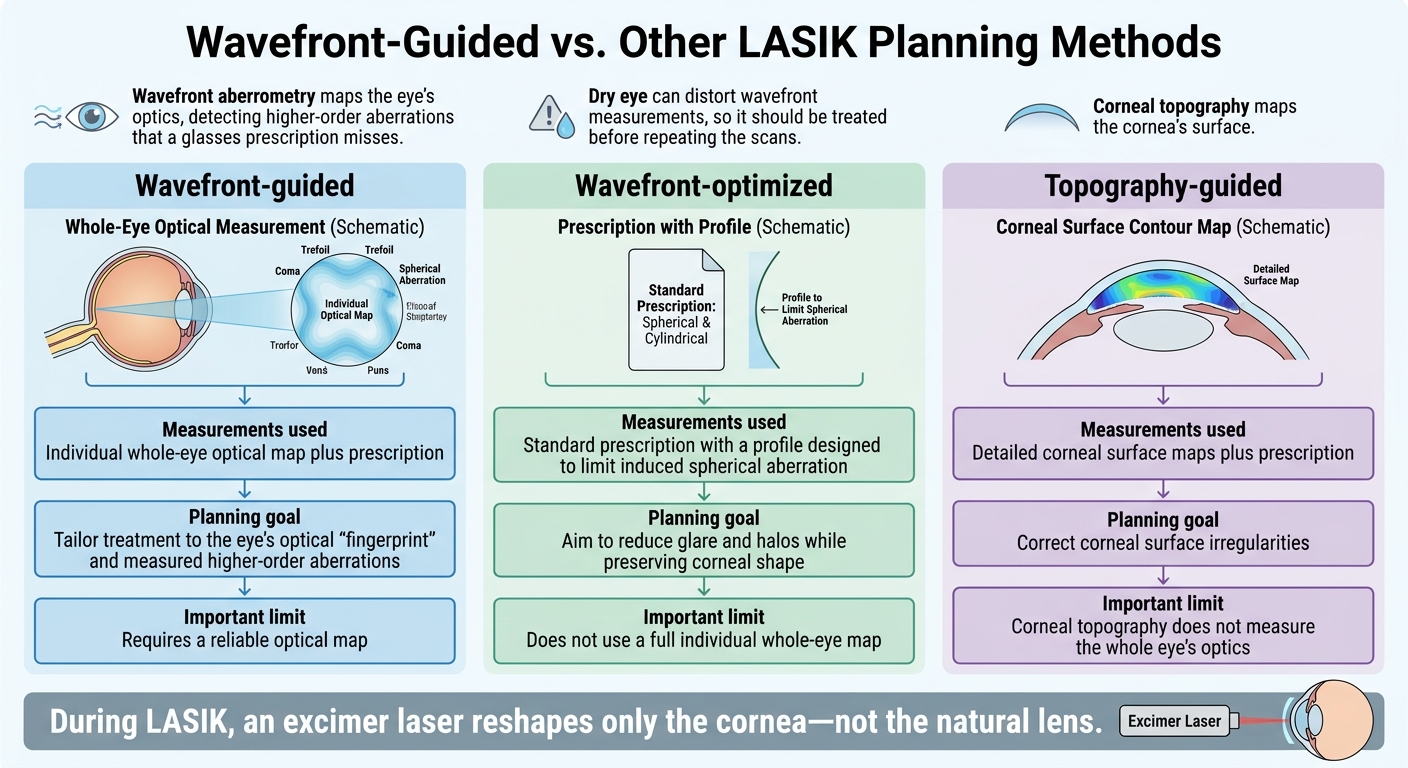
Wavefront-Guided vs. Other LASIK Planning Methods
Measuring Astigmatism and Higher-Order Aberrations
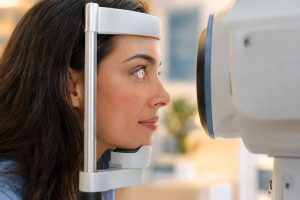
Precise eye measurements help guide treatment. Wavefront aberrometry maps the eye’s optics, detecting higher-order aberrations that a glasses prescription misses. Corneal topography maps the cornea’s surface.
Accurate scans start with careful pre-op testing. Dry eye can distort wavefront measurements, so it should be treated before repeating the scans.
From Optical Mapping to Laser Treatment
Treatment planning pairs your glasses prescription with your eye’s individual optical map. For astigmatism, this map helps the surgeon target uneven corneal curvature and turn the findings into a custom laser pattern.
During LASIK, an excimer laser reshapes only the cornea – not the natural lens.
The planning method helps determine which LASIK approach best matches your eye’s optics.
Wavefront-Guided, Wavefront-Optimized, and Topography-Guided LASIK
These names describe different ways to plan treatment.
| Approach | Measurements used | Planning goal | Important limit |
|---|---|---|---|
| Wavefront-guided | Individual whole-eye optical map plus prescription | Tailor treatment to the eye’s optical “fingerprint” and measured higher-order aberrations | Requires a reliable optical map |
| Wavefront-optimized | Standard prescription with a profile designed to limit induced spherical aberration | Aim to reduce glare and halos while preserving corneal shape | Does not use a full individual whole-eye map |
| Topography-guided | Detailed corneal surface maps plus prescription | Correct corneal surface irregularities | Corneal topography does not measure the whole eye’s optics |
Who May Qualify for LASIK
Wavefront mapping shows what can be treated. Candidacy screening checks whether LASIK is safe enough to proceed.
During your consultation, the surgeon checks your age, prescription stability, corneal thickness and shape, and tear-film health. Not every eye with astigmatism qualifies. Corneal shape and the eye’s ability to heal also matter. Age and prescription limits vary by device and treatment profile.
Findings That Support or Delay Surgery
| Screening area | Favorable findings | Concerns that may delay or rule out LASIK |
|---|---|---|
| Prescription | Stable for at least 12 months | Unstable or frequently changing prescription |
| Corneal thickness and shape | Enough thickness and a healthy, regular corneal shape | Thin or irregular corneas, keratoconus, or corneal scarring |
| Tear function | Healthy tear film and eye surface | Chronic or severe dry eye |
| Infection and scarring | No active infection or major scarring | Active infection or scarring that affects treatment |
| Health and medications | Conditions and medications compatible with healing | Conditions or medicines that may affect healing |
| Pregnancy or breastfeeding | Measurements are stable outside pregnancy and breastfeeding | Pregnancy or breastfeeding |
Some findings mean you’ll need treatment and repeat testing before surgery. Others rule out LASIK.
Tests Used to Check Eligibility
Testing usually includes:
- Refraction: Measures your prescription. When needed, cycloplegic refraction checks it with your eye’s focusing muscles relaxed.
- Wavefront aberrometry: Maps higher-order aberrations.
- Corneal topography and 3D tomography: Check corneal shape.
- Pachymetry: Measures corneal thickness.
- Tear-film testing: Checks for dry eye.
- Dilated exam: Checks internal eye health.
The residual stromal bed – the corneal tissue left under the flap – must remain thick enough. To plan safely, the surgeon considers your starting corneal thickness, flap thickness, how much tissue will be removed, and corneal shape.
Preparing for a Consultation in Boulder
Follow your surgeon’s instructions for pausing contact lens wear before testing. Bring your prescription history, full medical history, medication list, and notes about dryness or trouble driving at night. These details help the surgeon assess possible healing problems.
Boulder Eye Surgeons offers LASIK and PRK evaluations in Boulder. Ask whether wavefront-guided treatment fits your eyes and goals.
Once candidacy is confirmed, the discussion turns to vision goals, recovery, and treatment limits.
Vision Goals, Recovery, and Treatment Limits
Vision Goals and Early Recovery
If you qualify for LASIK, it helps to know what results to expect. For astigmatism, the goal is clearer distance vision with less distortion. Your results depend on your prescription, corneal health, and age. LASIK does not prevent cataracts or presbyopia.
Vision can fluctuate early in recovery. You may also notice dryness, glare, or halos as your eyes heal.
Potential Benefits and Treatment Limits
The wavefront map guides the laser and identifies what it can target. But your corneal health and prescription set limits on treatment, and corneal disease may rule out standard LASIK. A thorough eye evaluation helps determine whether LASIK is a good fit for your eyes.
| Possible benefits | Practical limit |
|---|---|
| Less dependence on glasses or contact lenses | Results vary by prescription, corneal health, and age. |
| Treatment tailored to your prescription and eye map | Some eyes may need a different procedure. |
Risks, Follow-Up, and Repeat Treatment
Your vision may change before it settles. Possible side effects include dry eye, glare, and halos. Follow-up visits let your surgeon check healing, address vision changes, and answer questions about your results. Once your eyes have healed, your surgeon will decide whether repeat treatment is appropriate.
Treatment Choices and Costs Before Surgery
Once you know you’re a LASIK candidate, it’s time to look at what surgery can correct, where it has limits, and what you’ll pay.
Types of Astigmatism LASIK Can Treat
LASIK can treat regular astigmatism. Irregular corneas need a different approach.
If LASIK Is Not Suitable
If LASIK isn’t right for your eyes, your options may include:
| Option | When it may be considered | Limit |
|---|---|---|
| Glasses | When you want correction without surgery | No surgery |
| Contact lenses | When nonsurgical correction suits your eyes and routine | Requires fitting and care |
| PRK | When corneal thickness or shape is a concern | Still depends on your exam |
| Implantable lens procedures | When corneal laser surgery isn’t appropriate | Depends on your eye anatomy |
| Refractive lens exchange (RLE) | When your surgeon recommends a lens-based approach | Depends on your eye findings |
Keratoconus or corneal ectasia after earlier surgery may call for other treatments rather than elective LASIK.
What to Check in a LASIK Price Quote
Ask for a written quote that spells out:
- Preoperative measurements, the procedure, facility fees, and follow-up visits.
- Whether future enhancement procedures are covered and what restrictions apply.
- Whether wavefront-guided or topography-guided mapping is included, since the technology used can affect the price.
Standard health insurance usually doesn’t cover elective refractive surgery, though benefits vary.
Conclusion: Deciding Whether LASIK Fits Your Eyes
Once you’ve reviewed recovery, limits, and costs, the decision comes down to whether LASIK fits your eyes. Wavefront-guided LASIK tailors corneal reshaping to your prescription and eye map, but realistic expectations matter.
At your consultation with Boulder Eye Surgeons, discuss how the procedure fits your vision goals and eye health. Ask why it was recommended and what other options you have.
Before booking surgery, confirm the total cost, preparation instructions, follow-up care, enhancement policy, contact lens restrictions, and transportation arrangements. Make sure you understand whether treatment fits your goals, what result to expect, and what comes next – not just how surgery works.
FAQs
How much astigmatism can wavefront-guided LASIK correct?
Wavefront-guided LASIK is generally a good fit for regular astigmatism below 2.50 diopters. Astigmatism above 2.50 diopters or irregular astigmatism may mean standard LASIK isn’t a safe option.
At Boulder Eye Surgeons, your surgeon uses corneal mapping and other diagnostic tests to examine your eye’s anatomy, including your cornea’s health and thickness. These tests help determine whether you’re a candidate.
When can I drive after LASIK?
You can usually drive at night after wavefront-guided LASIK once your vision has stabilized. Many patients see much better within 24 hours, though full stability can take a few months. Before driving at night, make sure your vision is clear and comfortable, and follow your surgeon’s specific recommendations at Boulder Eye Surgeons.
How do I know my wavefront scan is reliable?
Reliable wavefront scans start with a healthy, stable eye surface. Dry eye can disrupt your tear film and distort the measurements. Contact lenses can also temporarily change your cornea’s shape, so you’ll need to leave them out for the specified period before your exam.
At Boulder Eye Surgeons, your eye care team checks the health of your eye surface to help ensure accurate diagnostic images before finalizing your personalized treatment plan.