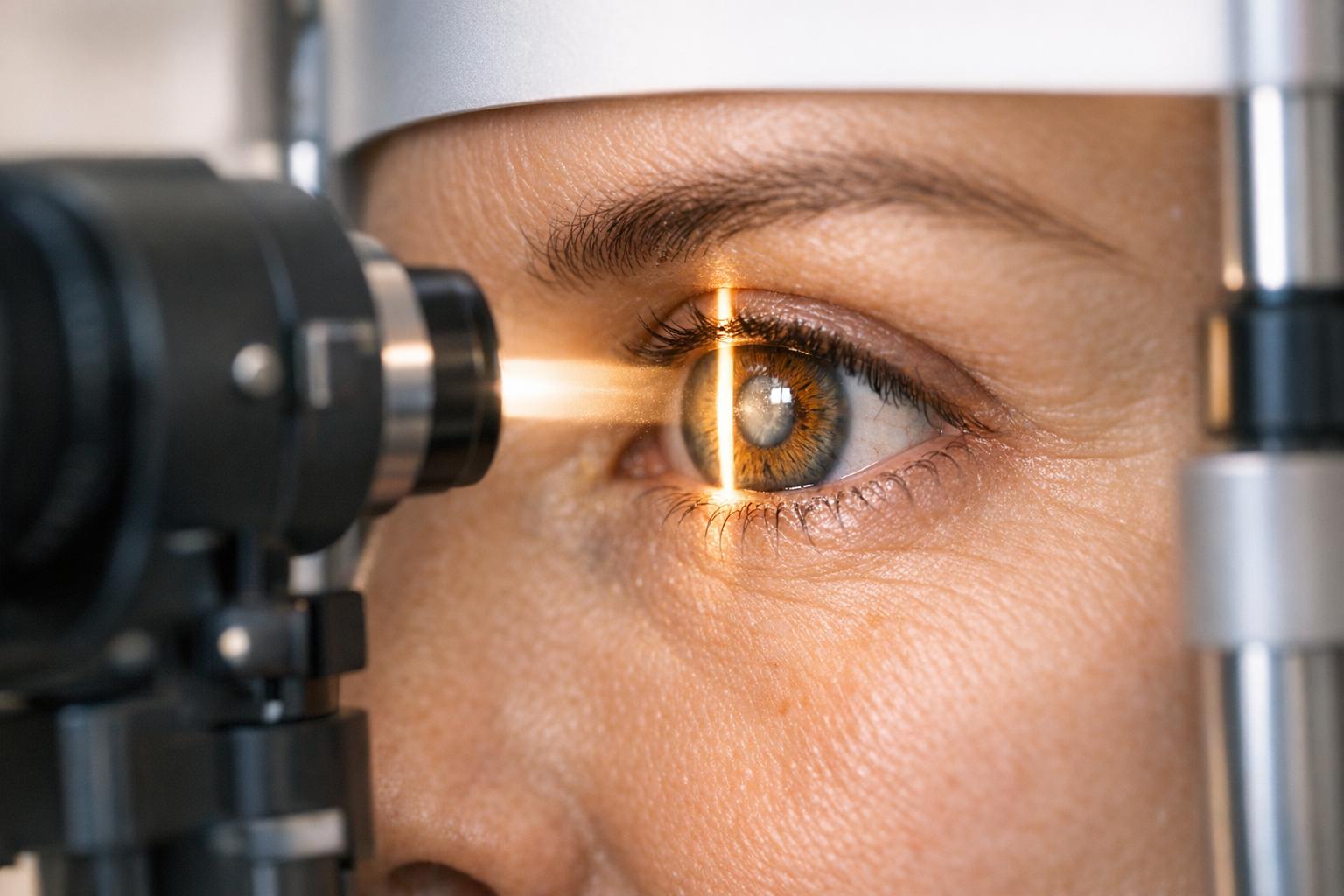
Regular eye exams are key to catching cataracts early, even before symptoms become noticeable. Cataracts, which cloud the eye’s lens, typically develop slowly over time and can lead to vision loss if untreated. Early detection allows for timely treatment, often preventing complications and improving outcomes.
Here’s what you need to know:
- Cataracts form when proteins in the eye’s lens clump together, causing blurry vision, faded colors, glare, and difficulty seeing in dim light.
- Common causes include aging, UV exposure, diabetes, smoking, and prolonged steroid use.
- Key tests during eye exams include:
- Visual Acuity Test: Measures clarity of vision.
- Slit-Lamp Exam: Identifies cloudiness in the lens.
- Dilated Retinal Exam: Provides a detailed view of the lens and retina.
- Advanced tools like Optical Coherence Tomography (OCT) and tonometry help assess the eye’s internal health and detect related issues.
Cataracts are common, affecting 20% of people aged 65–74 and over 50% of those 80 or older. Surgery is highly effective, with 90% of patients reporting improved vision. Regular eye exams starting at age 40 can help detect cataracts early, ensuring better treatment options and preserving vision.

How Eye Exams Detect Cataracts: 3 Primary Tests and Early Warning Signs
What Are Cataracts and Their Early Warning Signs
What Are Cataracts?
A cataract forms when the normally clear lens of your eye becomes cloudy over time, making it harder to see clearly. This happens due to protein breakdown in the lens, which creates opaque patches that block light. Imagine trying to look through a camera lens that’s been smudged – it’s not the lens itself that’s damaged, but the cloudiness makes it difficult to focus properly.
"A cataract is a clouding of the lens in the eye that commonly occurs with age. The lens focuses light onto the retina… With age, however, the protein can clump together and create a cloud in part of the lens." – NYU Langone
While aging is the most common cause of cataracts, several other factors can also play a role. These include eye injuries, prolonged use of steroids, diabetes, smoking, and too much exposure to UV light. Physical trauma to the eye or head, as well as complications from previous eye surgeries, can also increase the likelihood of developing cataracts. By the time people reach 75, most experience some vision changes due to cataracts. However, because the progression is gradual, spotting them early can be tricky.
Why Cataracts Are Hard to Detect Early
In the beginning stages, cataracts often don’t cause noticeable vision problems. The clouding tends to develop so slowly that it may take years before it starts interfering with daily life.
"Cataracts develop slowly and painlessly. Vision in the affected eye slowly gets worse." – MedlinePlus
Because early cataracts usually don’t cause discomfort or major visual changes, regular eye exams with dilation are key to catching them early. Many people don’t realize they have cataracts until their eye doctor spots them during a routine checkup. Over time, these subtle changes lead to specific symptoms, which we’ll cover next.
Early Symptoms to Watch For
When cataracts begin to affect your vision, the symptoms often start subtly. You might notice that your vision becomes blurry or hazy, and colors may appear dull or take on a yellowish tint. Bright lights can start to feel harsh, creating glare or halos – something you might especially notice while driving at night.
Other early signs include difficulty seeing in dim light, needing brighter lighting for reading, or even experiencing double vision in one eye. A frequent need to update your eyeglass prescription – especially if you’re over 40 – might also point to the development of a nuclear sclerotic cataract, which affects the center of your lens. Different types of cataracts can cause varying symptoms: cortical cataracts may impact your peripheral vision and depth perception, while posterior subcapsular cataracts can make it harder to read in bright conditions.
Primary Tests Used to Detect Cataracts During Eye Exams
Visual Acuity Test
The visual acuity test is one of the most common procedures during an eye exam. It involves reading a chart with letters that gradually decrease in size, testing each eye separately to measure how well you see at different distances . This test helps identify any changes in your vision since your last visit.
When it comes to cataract detection, this test can reveal how much the cloudiness in your lens is affecting your ability to see clearly. Struggling to read the chart, even with your current prescription, might be a sign that a cataract is forming . Your doctor might also shine a bright light into your eye during the test – this is called a glare test. It mimics situations like nighttime driving, where oncoming headlights can make it harder to see.
Slit-Lamp Examination
A slit-lamp examination uses a special microscope and a narrow, bright beam of light to closely examine the front parts of your eye, including the cornea, iris, and lens . The focused light allows your doctor to inspect the lens in thin sections, making it easier to pinpoint the location and severity of any cloudiness. This test can also reveal clumps of proteins in the lens, which are the root cause of cataracts.
Different types of cataracts have distinct patterns that your doctor can observe with this tool. For instance, nuclear sclerotic cataracts appear as yellowing and hardening in the center of the lens, cortical cataracts show spoke-like white streaks moving inward, and posterior subcapsular cataracts form small cloudy spots near the back of the lens, often causing significant glare. While the visual acuity test measures how well you can see, the slit-lamp exam provides a direct look at the physical changes in your lens. It can also detect inflammation or other issues in the spaces between the eye’s structures.
Retinal Exam with Dilation
In a retinal exam, your doctor uses eye drops to dilate your pupils, making them wider. This allows for a better view of the internal parts of your eye, including the lens, optic nerve, and retina. Once dilated, the doctor uses either a slit-lamp or a handheld ophthalmoscope to examine these structures in detail. This step is crucial for spotting cataracts early, as it offers an unobstructed view of the lens.
This exam also helps determine whether your vision issues are solely due to cataracts or if other conditions, like macular degeneration or diabetic retinopathy, might be contributing.
| Test Type | What It Reveals |
|---|---|
| Visual Acuity Test | Assesses vision clarity and the impact of lens cloudiness . |
| Slit-Lamp Exam | Examines the lens in detail to identify physical clouding and its characteristics . |
| Retinal Exam (Dilated) | Provides a clear view of the eye’s internal structures, including the retina and lens . |
Next, advanced imaging techniques and intraocular pressure measurements can provide even more detailed insights into cataract progression.
What to Expect: Eye Tests for Cataract and General Assessment
sbb-itb-c87b093
Additional Diagnostic Tools for Cataract Detection
In addition to standard tests, advanced imaging and measurement techniques provide more precision in cataract detection and help inform treatment plans.
Optical Coherence Tomography (OCT)
Optical Coherence Tomography (OCT) uses infrared light to create detailed cross-sectional images of the eye’s internal structures. Similar to how ultrasound employs sound waves, OCT relies on light waves to generate high-resolution, three-dimensional visuals. As the Cleveland Clinic explains, "Optical coherence tomography (OCT) is a noninvasive imaging method that eye care specialists use to produce cross-sectional images of your eye".
While OCT doesn’t directly diagnose cataracts, it highlights reduced image clarity caused by lens opacity. It’s also invaluable for assessing the retina and optic nerve for other conditions, such as macular degeneration or glaucoma. Anterior segment OCT, which focuses on the front of the eye, can assist in pre-surgical planning for cataract procedures and track changes over time by comparing scans.
Tonometry for Eye Pressure Measurement
Tonometry measures intraocular pressure (IOP), an important factor in eye health. Before performing this test, your doctor will usually apply numbing drops, then use a specialized device to gauge the pressure inside your eye. Though tonometry doesn’t directly identify cataracts, it helps differentiate vision loss caused by elevated IOP or glaucoma from other issues. This is particularly useful in patients with conditions like diabetes or a history of eye injuries, as advanced cataracts can sometimes lead to complications, such as leaking into other parts of the eye.
How Boulder Eye Surgeons Detects Cataracts Early

Boulder Eye Surgeons takes early cataract detection to the next level by combining advanced imaging technologies with expert care.
Advanced Technology and Expert Care
At Boulder Eye Surgeons, state-of-the-art diagnostic tools work hand-in-hand with the expertise of board-certified specialists to catch cataracts in their earliest stages. One standout tool is the OPD-Scan III Multifunction Diagnostic Device. This device performs multiple functions, including corneal topography, wavefront aberrometry, autorefraction, keratometry, and pupillometry. By generating Internal OPD Maps, it helps distinguish between corneal and internal aberrations, making it easier to identify cataracts as the cause of visual issues.
Another essential tool in their arsenal is the AL-Scan Optical Biometer. Using partial coherence interferometry, this device provides precise measurements and a detailed analysis of the eye’s health, ensuring a thorough evaluation every step of the way.
Tailored Care and Treatment Options
Thanks to these advanced diagnostics, Boulder Eye Surgeons creates care plans tailored to each patient’s unique lifestyle and vision needs. The team takes time to understand personal goals – whether it’s maintaining sharp vision for sports or other specific activities. As one patient, Michael L., shared:
"Dr. Cuevas… conducted a detailed pre-surgery consultation to tailor the treatment to my athletic vision needs".
The practice also empowers patients to decide on the timing of surgery, basing it on how cataracts impact daily life. For those in the early stages, their doctors recommend practical management strategies, such as updating prescriptions, improving lighting, and using anti-glare sunglasses. When surgery becomes the best option, Boulder Eye Surgeons offers a wide range of intraocular lens (IOL) options. These include monofocal and multifocal lenses, as well as Light Adjustable Lenses (LAL), which allow for post-surgery vision adjustments.
With cataract surgery success rates exceeding 95% and a 97% patient referral rate, Boulder Eye Surgeons demonstrates its commitment to personalized care and outstanding results. From early detection to customized treatment, their approach ensures patients receive the best possible outcomes.
Conclusion
Detecting cataracts early through regular eye exams is essential for maintaining both vision and quality of life. Comprehensive eye exams are especially important for those over 40, as regular dilated exams can catch cataracts before they begin to disrupt everyday activities like reading or driving.
The numbers speak for themselves: cataracts are one of the leading causes of blindness in the United States and worldwide. Nearly 20% of people aged 65 to 74 experience vision impairment from cataracts, and over half of Americans aged 80 and older have either developed cataracts or had surgery to remove them.
Early detection not only improves the success of cataract surgery but also helps preserve clearer vision. With tools like visual acuity tests, slit-lamp exams, and advanced imaging techniques such as OCT, ophthalmologists can identify protein clumping in the lens long before it begins to interfere with daily life. Early diagnosis can also prevent severe complications like hypermature cataracts, which may lead to painful conditions such as glaucoma or internal eye inflammation.
At Boulder Eye Surgeons, cutting-edge technology meets personalized care. Their advanced diagnostic equipment and tailored care plans ensure cataracts are detected early, aligning treatment options with each patient’s unique lifestyle and vision needs.
If you’re experiencing symptoms like blurred vision, increased glare, or trouble seeing at night, don’t wait. Schedule a comprehensive eye exam today and take the first step toward protecting your vision.
FAQs
What are the early signs of cataracts to look out for?
Cataracts often start with subtle changes in your vision. You might notice cloudy or blurred vision, difficulty seeing at night, or increased sensitivity to bright lights and glare. Some people report seeing halos around lights, while others find that colors look dull or yellowed. You could also find yourself needing brighter light for reading or frequently updating your glasses or contact lens prescription. In some cases, double vision in one eye may occur.
If any of these symptoms sound familiar, it’s a good idea to book an eye exam. Catching cataracts early can help ensure you get the right care and treatment options to suit your needs.
How often should I get an eye exam to detect cataracts early?
To stay ahead of cataracts, make it a habit to schedule a comprehensive eye exam every year. These regular check-ups give your eye doctor the chance to track any changes in your vision and spot cataracts or other eye issues before they become a bigger problem.
If you notice symptoms like blurry vision, heightened sensitivity to light, or trouble seeing clearly at night, don’t wait for your next routine exam – book an appointment as soon as possible. Catching cataracts early can make a big difference in your treatment options and results.
How are cataracts detected during routine eye exams?
During regular eye exams, cataracts can often be identified early thanks to advanced diagnostic tools and techniques. Ophthalmologists frequently rely on slit-lamp examinations to get a detailed look at the lens, checking for any cloudiness or irregularities. Additionally, retinal imaging and optical coherence tomography (OCT) are widely used to produce high-resolution images of the eye’s internal structures, offering a clear view of the lens, retina, and nearby tissues.
In certain situations, more specialized technologies, such as dynamic light-scattering analysis or AI-powered imaging systems, may be employed to improve detection precision. Routine eye exams play a crucial role in catching cataracts early, allowing for timely intervention and helping to maintain healthy vision.