LASIK is a quick, effective procedure to correct vision problems like nearsightedness, farsightedness, and astigmatism – even for seniors. If you’re over 50 and tired of glasses or contacts, this option might be worth considering. However, it’s not for everyone. Here’s what you need to know:
- How it works: LASIK reshapes the cornea with a laser to improve vision. Recovery is typically fast, with most patients returning to normal activities within days.
- Eligibility: Stable vision and healthy corneas are key. Conditions like cataracts, severe dry eye, or autoimmune diseases may disqualify you.
- Risks: Common issues include dry eye symptoms, glare, and halos at night. LASIK may also complicate future cataract surgeries.
- Benefits: Many achieve 20/20 vision and gain independence from glasses. Monovision techniques can help with age-related near vision loss.
- Alternatives: Comparing LASIK vs PRK or lens-based procedures may be better for those with thin corneas or cataracts.
The decision depends on your eye health, lifestyle, and goals. A thorough evaluation with a qualified surgeon is essential to determine if LASIK is the right fit for you.
Eligibility Criteria for Seniors
Health and Vision Requirements
When it comes to LASIK, age alone isn’t the deciding factor – your overall eye health plays a big role. One key requirement is having a stable prescription. If your eyeglass or contact lens prescription hasn’t changed for at least 12 months, that’s a good sign you might qualify.
Healthy corneas are also a must. Using advanced tools like corneal topography, doctors check for adequate corneal thickness and overall health. Certain conditions can interfere with the surgery or the healing process, so these evaluations are crucial.
Cataracts, for example, are a major roadblock. LASIK can’t correct vision problems caused by a clouded lens, so cataract surgery would need to come first. Often, premium intraocular lenses used during cataract surgery can provide the vision improvements you’re looking for, eliminating the need for LASIK altogether.
Dry eye syndrome is another factor to consider, especially since it’s common in people over 50. LASIK can sometimes worsen dryness – about 30% of patients report dry eye symptoms after surgery. If you have severe dry eye, this might disqualify you. However, mild dryness or conditions like blepharitis (eyelid inflammation) can often be treated before surgery, making LASIK a safer option.
These health criteria are essential in determining whether LASIK is a safe and viable choice for you.
Who May Not Be a Candidate?
Even if you meet the basic health and vision requirements, certain conditions or medications might make LASIK unsuitable for you.
Autoimmune diseases like rheumatoid arthritis or lupus, uncontrolled diabetes, and uncontrolled glaucoma can all affect healing and may disqualify you from the procedure. Thin corneas are another common issue – if your corneas can’t be safely reshaped, LASIK isn’t an option. However, alternative procedures like PRK might still work for you.
Some medications can also interfere with the healing process or affect your vision stability. Oral steroids, certain heart medications like Cardarone, and migraine treatments such as Imitrex are known to pose risks. Dr. Wuqaas M. Munir, an Associate Professor of Ophthalmology at the University of Maryland Medical System, explains:
"They [health conditions] don’t necessarily mean that you can’t have the surgery, but there are risk factors for healing".
Ultimately, about 15% to 20% of patients who inquire about LASIK are found ineligible due to various health or eye conditions. A thorough pre-surgical evaluation will help determine if LASIK is the right choice for you.
sbb-itb-c87b093
Can You Have LASIK Surgery After 50? (EYE EXPERT ADVICE)
Benefits of LASIK for Seniors
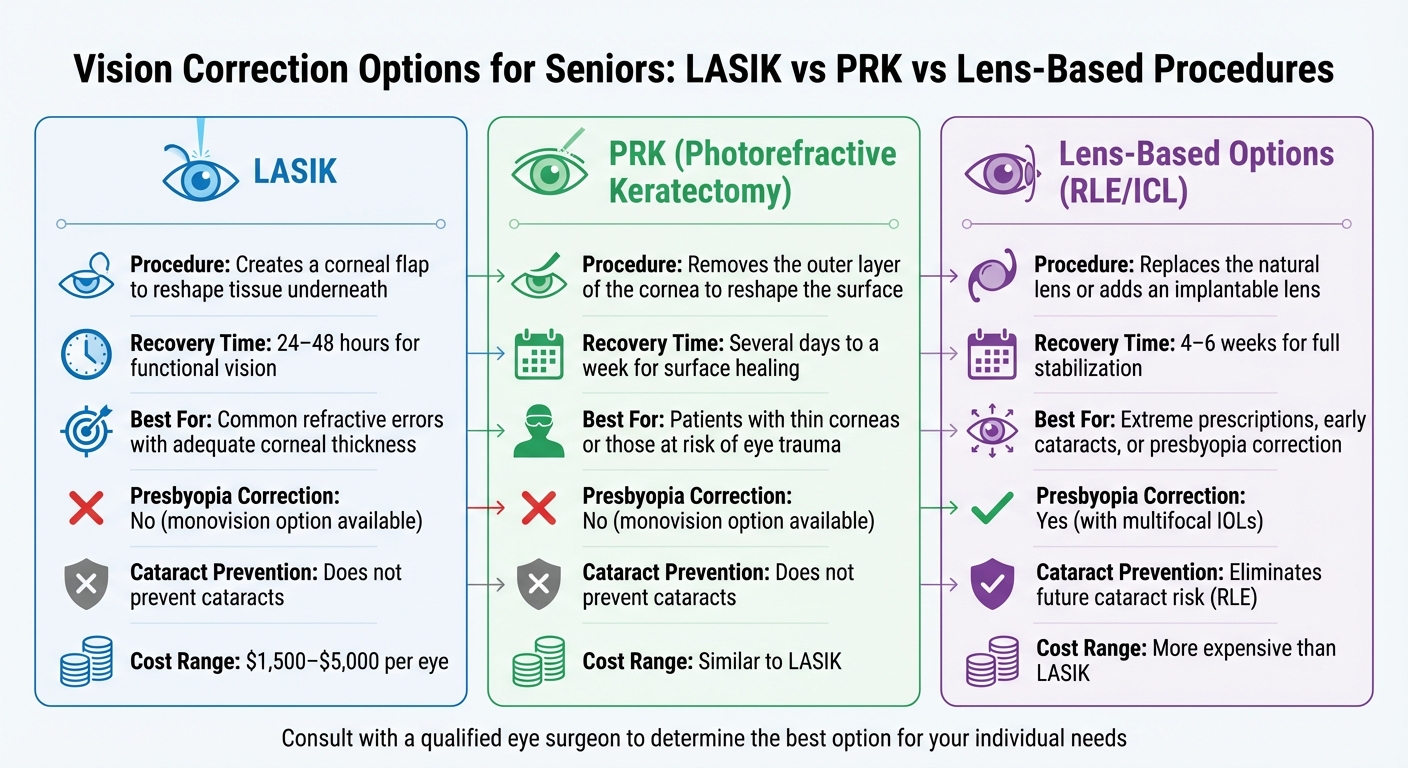
LASIK vs PRK vs Lens-Based Vision Correction Options Comparison
Improved Vision and Independence
LASIK can reduce or even eliminate the need for glasses, giving seniors greater independence and simplifying their everyday lives.
As Eric Polk, OD, FAAO, and Instructor at Ophthalmology and Visual Sciences, explains:
"Being less dependent on glasses can also enhance independence and confidence, particularly for seniors who may struggle with handling and maintaining corrective eyewear."
Although LASIK doesn’t correct presbyopia (the age-related difficulty with near vision), there’s an option called the "monovision" technique. This approach corrects one eye for distance and the other for close-up tasks. Doctors often recommend trying monovision contact lenses first to see how well your brain adapts to the adjustment.
High Success Rates and Quick Recovery
LASIK is known for its effectiveness and quick recovery time. Most patients report noticeable improvements in vision within 24 hours and can return to their regular activities within just a few days. In fact, about 95% of patients express satisfaction with the results.
A study that looked at 424 LASIK patients aged 40 to 60 found that surgical outcomes were generally consistent, regardless of age. While older patients might need a slightly longer healing period compared to younger adults, the procedure permanently reshapes the cornea, offering long-term benefits.
These results underscore LASIK’s potential as a practical and effective option for seniors seeking vision correction.
Comparison with Other Vision Correction Options
When considering LASIK, it’s helpful to compare it with other available procedures to determine which option aligns best with your needs.
| Feature | LASIK | PRK (Photorefractive Keratectomy) | Lens-Based Options (RLE/ICL) |
|---|---|---|---|
| Procedure | Creates a corneal flap to reshape tissue underneath | Removes the outer layer of the cornea to reshape the surface | Replaces the natural lens or adds an implantable lens |
| Recovery Time | 24–48 hours for functional vision | Several days to a week for surface healing | 4–6 weeks for full stabilization |
| Best For | Common refractive errors with adequate corneal thickness | Patients with thin corneas or those at risk of eye trauma | Extreme prescriptions, early cataracts, or presbyopia correction |
| Presbyopia Correction | No (monovision option available) | No (monovision option available) | Yes (with multifocal IOLs) |
| Cataract Prevention | Does not prevent cataracts | Does not prevent cataracts | Eliminates future cataract risk (RLE) |
In the U.S., LASIK costs typically fall between $1,500 and $5,000 per eye. Lens-based surgeries, such as RLE, tend to be more expensive but offer the added benefit of correcting both distance vision and presbyopia. These procedures are particularly appealing for seniors with early-stage cataracts.
For those considering laser vision correction, Boulder Eye Surgeons offers personalized consultations and advanced LASIK procedures. Their patient-focused approach ensures you receive expert care tailored to your unique vision needs, helping you regain clarity and independence.
Risks and Considerations for Older Patients
Common Risks and Complications
LASIK is generally considered a safe procedure, but older adults may face specific challenges. One common issue is dry eye syndrome, which affects 30%–50% of LASIK patients. This condition is even more prevalent among seniors due to reduced tear production, particularly after menopause. LASIK also severs corneal nerves responsible for tear signaling, which can exacerbate preexisting dry eye problems.
Another consideration is the potential impact on future cataract surgery. Cataracts are common among older adults, with about 50% of individuals aged 60–74 and 70% of those 75 and older developing them. LASIK can complicate the process of calculating the correct power for intraocular lenses during cataract surgery. To address this, surgeons often recommend obtaining an American Academy of Ophthalmology "K card", which records pre- and post-surgery eye measurements – critical for accurate lens selection.
Additionally, LASIK thins the cornea, leading to artificially low intraocular pressure readings. This can make it harder to detect early-stage glaucoma. Some patients also experience visual disturbances like glare, halos, and starbursts, which can persist beyond six months. While only 5% of patients find these effects bothersome, they can make tasks like night driving more difficult, even with 20/20 vision.
Managing Expectations
Understanding these risks is key to managing expectations. For seniors, it’s important to recognize LASIK’s limitations. While the procedure reshapes the cornea to improve distance vision, it doesn’t address presbyopia, the age-related stiffening of the eye’s lens that makes reading small text challenging. Dr. Ula Jurkunas, Assistant Professor of Ophthalmology at the Massachusetts Eye and Ear Infirmary, highlights this limitation:
"Even if you have one eye corrected for near vision, you may still be more comfortable wearing glasses for prolonged reading".
It’s also worth noting that vision may take weeks to six months to stabilize after surgery, and older patients may be more likely to require enhancement treatments. Despite these considerations, LASIK boasts a high satisfaction rate – about 95% of patients are happy with their results, and over 99% experience no serious complications.
Ultimately, setting realistic expectations and having an open discussion with your surgeon about your health, medications, and lifestyle needs is essential. These conversations will help you decide if LASIK aligns with your vision goals. For those considering the procedure, consulting with experienced professionals like the team at Boulder Eye Surgeons (https://bouldereyesurgeons.com) is a great step toward making an informed decision.
Pre-Surgery Evaluation Process
Tests and Assessments
Before undergoing LASIK, you’ll need a detailed pre-surgery evaluation. Surgeons take this step seriously, with some specialized clinics declining up to 33% of patients to maintain high success rates. In fact, about 20% of people who seek LASIK are deemed ineligible due to underlying medical or eye conditions. This careful screening process ensures safer outcomes and reinforces confidence in the procedure.
The evaluation involves several key tests, including corneal mapping, pachymetry, wavefront analysis, pupillometry, tear film evaluation, and a dilated retina exam. Corneal mapping uses advanced imaging to create a 3D map of your cornea, helping guide the laser during surgery. Pachymetry measures the thickness of your cornea to confirm there’s enough tissue for safe reshaping. Wavefront analysis tracks how light passes through your eye, identifying any irregularities that need correction.
For older patients, pupillometry – which measures pupil size in different lighting conditions – is particularly important. Larger pupils can increase the risk of post-surgery night vision issues, such as halos or glare. A tear film evaluation checks for dry eye syndrome, which needs to be treated before surgery to ensure proper healing. Additionally, a dilated retina exam evaluates the health of your retina and screens for age-related conditions like cataracts, glaucoma, or macular degeneration. These tests are especially critical for seniors, as they address unique concerns and help customize the LASIK plan to your needs.
Your surgeon will also verify that your prescription has been stable for at least 6 to 12 months. They’ll review your medical history and medications, as certain conditions – like diabetes or autoimmune diseases – and medications such as steroids or immunosuppressants can impact healing.
Once all the tests are complete, your surgeon will walk you through the results, outline the next steps, and answer any questions you may have.
What to Expect During the Consultation
During your consultation, your surgeon will discuss your vision goals and what results you can realistically expect. Since LASIK doesn’t correct presbyopia (the age-related difficulty in reading up close), they may suggest monovision, a technique where one eye is corrected for distance vision and the other for near vision. To see if this approach works for you, doctors often recommend trying it out with contact lenses first.
There are a few things to keep in mind before your consultation. You’ll need to stop wearing contact lenses several weeks beforehand, as they can temporarily alter your cornea’s shape, affecting measurement accuracy. Bring a list of any medications or supplements you take, as some may interfere with healing. Since your eyes will be dilated during the exam, bring sunglasses and arrange for someone to drive you home afterward.
If you have persistent dry eye symptoms, starting treatments like artificial tears or flaxseed supplements ahead of time can improve your chances of being a good candidate. Clinics like Boulder Eye Surgeons offer free consultations, guiding you through the process and helping determine if LASIK is right for you based on your specific eye health and vision needs.
Conclusion
Whether LASIK is right for you depends on factors like stable vision, healthy corneas, and your specific lifestyle needs. Age, by itself, isn’t a dealbreaker; what truly matters is having a consistent prescription and realistic expectations about what the procedure can achieve. While LASIK is designed to reshape the cornea for better distance vision, it doesn’t address presbyopia. This means you might still need reading glasses or consider a monovision solution.
The procedure boasts high success rates and minimal risks, making it a dependable choice for many. That said, seniors should be evaluated carefully for conditions like cataracts, glaucoma, or chronic dry eye, as these can influence whether LASIK is the right path.
"LASIK surgery for seniors can indeed be a viable option for improving vision and reducing dependency on glasses. However, the decision to undergo LASIK should be made after careful consideration, consultation, and evaluation by a qualified eye care professional."
- Ophthalmology & Visual Sciences, Washington University School of Medicine
Ready to explore your options? Start by scheduling a comprehensive evaluation with a trusted eye care professional. Boulder Eye Surgeons offers free LASIK consultations, where their experienced team will assess your corneal thickness, tear production, and overall eye health to determine your eligibility. With a 97% patient referral rate, their personalized approach ensures you’ll receive expert advice tailored to your needs.
After a thorough evaluation, you can choose the solution that best aligns with your goals – whether it’s reducing your reliance on glasses or supporting an active lifestyle. Visit the Boulder Eye Surgeons website to schedule a consultation and take the first step toward sharper, clearer vision.
FAQs
Can I get LASIK if I have cataracts?
If you have cataracts, LASIK is usually not the go-to option. Cataracts can disrupt the precision of the procedure and may impact how stable your vision remains over time. Typically, cataract surgery is done first to clear up cloudy vision. Afterward, if necessary, LASIK or other vision correction methods might be explored to refine your eyesight further.
For the best course of action, it’s wise to consult with an eye care specialist who can guide you toward the treatment plan that suits your individual needs.
What are the potential risks of LASIK for seniors with dry eye syndrome?
Seniors dealing with dry eye syndrome might experience a higher likelihood of prolonged or intensified dry eye symptoms after LASIK. This happens because age-related changes in tear production can make it more challenging for the eyes to heal completely. In some instances, these symptoms may linger for months or even longer after the surgery.
If you have dry eye syndrome, it’s crucial to talk with a skilled LASIK provider about your condition. They can assess your eye health and suggest the most suitable options to enhance your vision while reducing the chances of discomfort.
Can having LASIK affect cataract surgery later in life?
Undergoing LASIK can influence how cataract surgery is planned later in life. Since LASIK reshapes the cornea, it can make determining the correct intraocular lens (IOL) power for cataract surgery more complex. Thankfully, modern diagnostic tools and advanced formulas help eye surgeons achieve precise measurements and excellent results. If LASIK is on your radar, be sure to talk with your doctor about your long-term vision goals. This way, you can ensure your eyes receive the best care now and down the road.