
Monovision surgery is a vision correction technique designed for people over 40 dealing with presbyopia, a common age-related condition that makes near objects harder to see. This procedure corrects one eye for distance vision and the other for near vision, helping reduce reliance on glasses or contacts. It’s commonly performed via LASIK, PRK, or during cataract surgery, and about 10 million Americans already benefit from it.
Here’s a quick overview of what you need to know:
- Candidates: Best suited for individuals over 40 with presbyopia and healthy eyes. Certain conditions like glaucoma or severe dry eye may disqualify candidates.
- Trial First: A contact lens trial is recommended to simulate monovision and assess your brain’s ability to adjust.
- Procedure: Quick outpatient surgery (10–15 minutes per eye) using lasers or intraocular lenses, depending on your needs.
- Recovery: Initial symptoms like mild discomfort or blurry vision usually subside in hours. Full adjustment can take weeks to months.
- Pros: Reduces dependence on reading glasses and bifocals for everyday tasks.
- Cons: May affect depth perception, night vision, and certain activities like sports or driving.
Monovision isn’t for everyone, but it can be a practical option if you’re looking to simplify your vision needs. Always consult with a specialist to determine if this procedure aligns with your lifestyle.
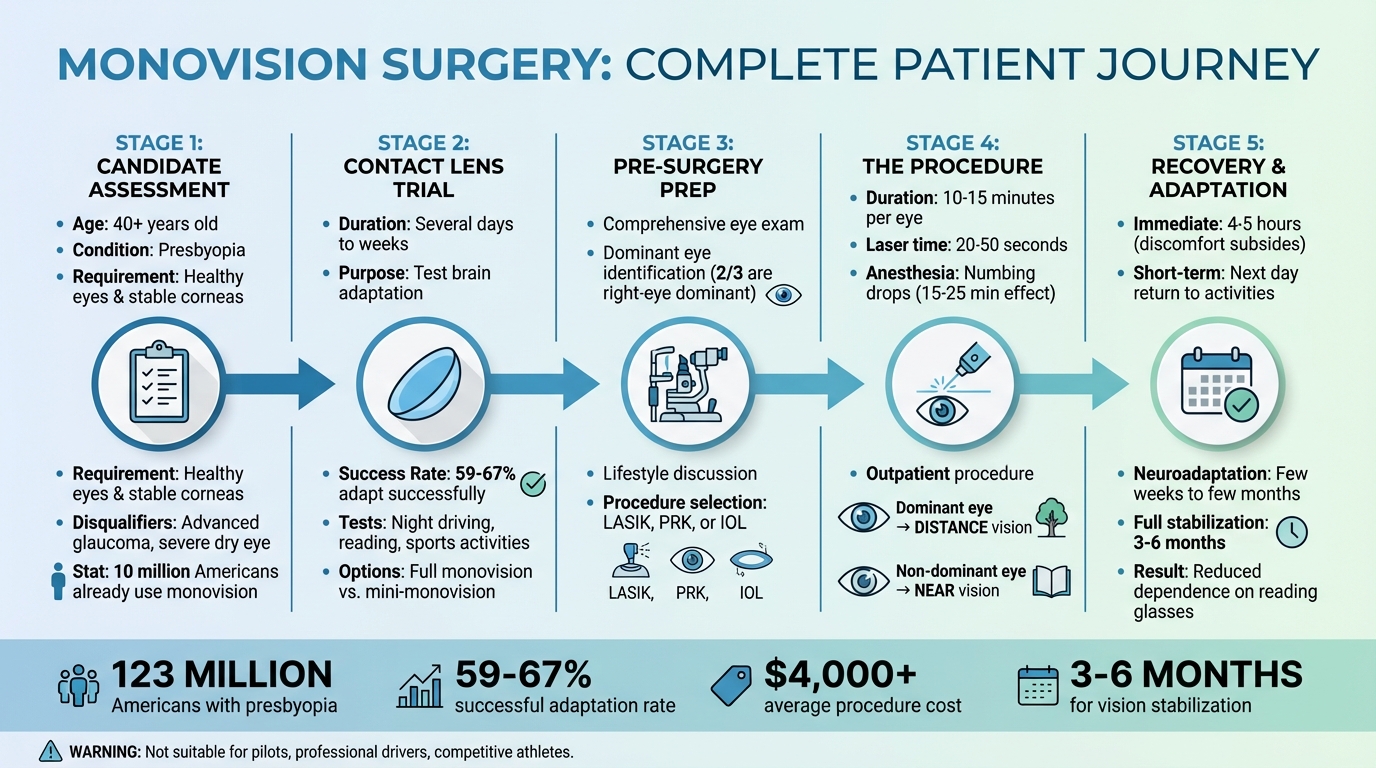
Monovision Surgery Journey: From Consultation to Recovery Timeline
Monovision: distance & near vision w/ contacts, LASIK, lens implants – A State of Sight #34
Who Should Consider Monovision Surgery?
Monovision surgery isn’t the right choice for everyone, but for the right candidates, it can be a game-changer. Whether or not it’s a good fit for you depends on factors like your age, overall eye health, and how well you can adapt to the changes it brings.
Age and Vision Requirements
Monovision surgery is typically recommended for those aged 40 and older who are dealing with presbyopia – the natural, age-related decline in near vision. If you’ve started holding menus or your phone farther away to read clearly, you might be an ideal candidate. This procedure is especially appealing to people who want to ditch their reading glasses or bifocals. It’s also versatile enough to correct various refractive issues, whether you’re nearsighted, farsighted, or simply struggling with age-related vision challenges.
Eye Health Requirements
Healthy eyes and stable corneas are crucial for this procedure. Certain eye conditions, such as advanced glaucoma or severe dry eye, may rule out monovision surgery as an option. Additionally, your overall health plays a role. For instance, conditions like Type 2 diabetes can affect both your eye health and your recovery process. However, even if you have cataracts, you might still qualify for monovision surgery if specific intraocular lenses are used during cataract procedures.
Testing Monovision with Contact Lenses
Before making a permanent decision, trying monovision with contact lenses is essential. This trial gives you a chance to experience how monovision affects your daily life without committing to surgery. Typically lasting several days to weeks, the trial allows your brain to adjust to relying on one eye for near vision and the other for distance. Studies show that about 59% to 67% of people successfully adapt to monovision correction with contact lenses.
"Patients who do well with the contact lens trial overwhelmingly do well with monovision LASIK." – EyeWiki
During the trial, it’s important to test how monovision works during various activities, like driving at night, reading for extended periods, or playing sports. If your lifestyle involves tasks requiring precise depth perception – such as piloting, long-haul truck driving, or competitive sports – monovision might not be the best fit. The trial also helps determine whether full monovision, which prioritizes near vision, or mini-monovision, which balances near and distance vision, suits you better. Once the trial concludes, you’ll be ready to move forward with the next steps in preparing for surgery.
How to Prepare for Monovision Surgery
Once you’ve had a successful contact lens trial, it’s time to focus on preparation. This phase is all about ensuring you’re ready for the procedure and understanding what to expect for the best possible results.
Eye Examination
At Boulder Eye Surgeons, a thorough eye exam is a critical first step in preparing for monovision surgery. This detailed evaluation will confirm your suitability for the procedure. During the exam, your surgeon will assess your refractive state, check if your prescription has remained stable, and evaluate the overall health of your eyes. They’ll also examine the structure of your eyes to rule out potential complications and ensure your corneas are in good condition for surgery. This comprehensive assessment helps tailor the procedure to your specific needs.
Identifying Your Dominant Eye
Knowing which eye is dominant is a key part of planning monovision surgery. Fun fact: about two-thirds of people are right-eye dominant, while the remaining third are left-eye dominant. Your surgeon typically corrects the dominant eye for distance vision and the non-dominant eye for near vision. To determine dominance, tests like the Miles Test are used. This simple test involves creating a triangle with your hands, focusing on an object, and observing which eye keeps the object in view when alternately closing each eye. These insights ensure the surgery aligns with your visual requirements.
Discussing Your Lifestyle and Depth Perception
Your lifestyle and daily habits play an important role in deciding the best monovision approach for you. Since monovision can reduce depth perception, it might affect certain activities. For example, if you’re a pilot, long-haul truck driver, or frequently drive at night, you might experience challenges like glare, halos, or reduced clarity for distance vision. Similarly, activities requiring precise depth perception – like sports or night driving – might make full monovision less suitable.
In such cases, your surgeon may suggest mini-monovision, which strikes a balance between near and distance vision. While full monovision offers excellent near vision, it can create a larger imbalance. Mini-monovision, on the other hand, provides better distance clarity and is easier to adapt to, though you may still need reading glasses for very fine print. This tailored approach ensures your vision matches your lifestyle needs.
What Happens During the Procedure
Monovision surgery is a quick outpatient procedure, typically completed in just a few minutes per eye. To ensure comfort, numbing drops are applied to your eyes, lasting about 15 to 25 minutes. In some cases, a mild sedative may also be provided to help you feel more at ease during the process.
The Surgical Process
The exact technique used in monovision surgery depends on your specific vision needs and the overall health of your eyes. For laser-based procedures like LASIK or PRK, advanced lasers are used to reshape the cornea. In LASIK, a small flap is created to access the underlying corneal tissue, while PRK works directly on the surface of the cornea. The laser portion of the surgery is remarkably fast – typically, the first laser takes about 20 seconds, and the second laser takes between 10 and 50 seconds, depending on your prescription. The dominant eye is adjusted for distance vision, while the non-dominant eye is fine-tuned for near vision.
For patients with cataracts or those undergoing refractive lens exchange (RLE), the procedure is different. Instead of reshaping the cornea, the natural lens of the eye is replaced with an artificial intraocular lens (IOL). One IOL is designed for distance vision, and the other is set for near vision.
"Monovision cataract surgery replaces the natural lens with an intraocular lens (IOL) that corrects for distance vision in one eye and for near vision in the other eye. The brain switches between the eyes as a person’s gaze shifts." – Dr. Sonia Kelley, OD, MS
This precise approach, combined with the short duration of the procedure, highlights the efficiency of monovision surgery.
Procedure Duration and Comfort
The surgery itself is brief, usually lasting just 3 to 15 minutes per eye. Thanks to numbing drops, you won’t feel pain, though you might notice slight pressure during the corneal reshaping or lens placement. Throughout the procedure, your surgeon keeps a close watch on your eye using a microscope and may talk you through each step, so you’re aware of what to expect in terms of sensations and sounds.
After the surgery, patients are encouraged to rest with their eyes closed for several hours. It’s normal to experience temporary symptoms like watery eyes or a mild burning sensation. Most people can return to their usual activities the next day, although it may take a little longer for your vision to fully adjust to the changes.
At Boulder Eye Surgeons, the skilled team uses advanced techniques and prioritizes personalized care to ensure a comfortable experience and the best possible results for your vision correction.
sbb-itb-c87b093
Recovery After Monovision Surgery
What to Expect Right After Surgery
In the hours immediately following monovision surgery, it’s common to feel some temporary discomfort. You might notice burning, itching, or a sensation as if something is in your eye. Your eyes may water, your vision could appear hazy, and you might be sensitive to light. Glare, starbursts, or halos around lights are also possible, and the whites of your eyes might look red or bloodshot. These effects usually fade within four to five hours, while the numbing drops used during surgery wear off within 15 to 25 minutes.
It’s important to avoid rubbing your eyes during this time, as doing so could disrupt the corneal flap created during the procedure. To protect your eyes, especially while sleeping, use the eye shield provided by your surgeon. Many patients can return to most of their normal activities the next day, but taking a few days off work can help minimize eye strain as your vision adjusts. Once the initial symptoms subside, your brain begins the process of adapting to your new vision.
The Adjustment Period
Adapting to monovision requires your brain to undergo a process called neuroadaptation. This is where your brain learns to prioritize the clearer image from each eye, allowing you to function effectively with the new visual setup. This adjustment period can take anywhere from a few weeks to a few months.
"Healing time is usually short, but it may take a few weeks up to a few months for the brain to adjust to monovision." – SharpeVision
For most patients, vision stabilizes between three and six months. Studies show that around 59% to 67% of patients successfully adapt to monovision correction. This neuroadaptation is key to achieving comfortable, functional vision for everyday tasks. Engaging in your daily routine during this time can help your brain practice and adjust more effectively.
Long-Term Vision Results
After the adjustment phase, your vision stabilizes, and many patients find they rely far less on reading glasses for tasks like checking their phone or reading a menu. This reduced dependence is often the primary goal of monovision surgery. However, there are trade-offs. Because your eyes no longer focus on the same point together, you may notice a slight, permanent reduction in depth perception and contrast sensitivity. These changes can be more noticeable in low-light situations or while driving at night.
Some patients choose to keep part-time glasses for specific activities, like night driving in rainy conditions, to enhance depth perception. It’s also worth noting that monovision surgery doesn’t stop the natural aging of the eye’s lens. Over time, near vision may continue to decline, and in such cases, an enhancement procedure might be recommended to refine your distance vision.
Benefits and Drawbacks of Monovision Surgery
After recovery, it’s important to weigh the key advantages and disadvantages of monovision surgery.
Benefits of Monovision Surgery
One of the biggest perks of monovision surgery is the freedom from reading glasses. Many patients find they can handle everyday tasks – like reading books or working on screens – without needing corrective eyewear.
Though the upfront cost of monovision LASIK can be steep, averaging over $4,000 (about $2,000 per eye), it can help cut down on the recurring expense of glasses or contact lenses. Recovery is usually quick, with most people returning to their normal routines shortly after LASIK or PRK procedures. For those undergoing cataract surgery, monovision intraocular lenses provide a dual benefit: they address both cataracts and presbyopia in one go.
Drawbacks of Monovision Surgery
On the flip side, monovision surgery comes with its challenges. A major downside is reduced depth perception. Since each eye focuses at a different distance, they may not work together seamlessly, which can affect three-dimensional vision. Tasks like playing sports that require precise distance judgment or parking in tight spots can become trickier. Night driving also poses a challenge for some, as glare, halos, and starbursts around lights can become more pronounced.
There’s also the potential for the Pulfrich effect, where uneven image processing between the eyes can lead to issues with judging distance and motion. Studies indicate that only 59% to 67% of patients fully adapt to monovision correction. This means around one in three individuals could face ongoing issues, such as headaches, eye strain, or discomfort. Additionally, certain jobs – like piloting, professional driving, or playing sports at a high level – may not be well-suited to monovision due to the need for precise depth perception.
Comparison Table
| Feature | Benefits | Drawbacks |
|---|---|---|
| Visual Freedom | Less dependence on reading glasses for daily tasks | Might still need glasses for night driving or specific tasks |
| Depth Perception | Works well for most activities | Noticeable drop in 3D vision; impacts sports and precision tasks |
| Night Vision | Clearer distance vision in one eye | Increased glare, halos, and starbursts around lights |
| Adaptation | Most people adjust within weeks | Some may experience ongoing eye strain or motion misjudgment |
| Permanence | Long-lasting solution for presbyopia | Reversing the procedure may require additional surgeries |
Conclusion
Monovision surgery offers a practical solution for 123 million Americans dealing with presbyopia by correcting one eye for distance vision and the other for near vision. This approach allows your brain to adapt and blend the two focal points, making it easier to reduce reliance on reading glasses for daily activities.
The procedure itself is quick – just 10 to 15 minutes per eye – but the real transformation happens during the adjustment period as your brain learns to work with the new vision setup. Before committing to surgery, a successful contact lens trial is crucial to confirm that your brain can handle this unique adjustment.
Whether monovision is a good fit for you depends largely on your lifestyle and visual needs. For those who require precise depth perception – think professional drivers or athletes – the trade-offs might not be worth it. However, if you’re ready to ditch reading glasses and can accept some limitations in specific situations, monovision could make a noticeable difference in your day-to-day life. Choosing a provider with experience in personalized monovision setups is key to ensuring the best outcome.
At Boulder Eye Surgeons, the team offers extensive preoperative evaluations, including ocular dominance testing and mandatory contact lens trials, to confirm you’re a suitable candidate. They also tailor the correction to your needs, whether you’re looking for full monovision for optimal reading or mini-monovision for easier adaptation.
Ready to explore your options? Schedule a consultation with Boulder Eye Surgeons at bouldereyesurgeons.com to see if monovision surgery aligns with your vision goals and lifestyle. Their personalized care ensures you fully understand both the benefits and potential trade-offs before making your decision.
FAQs
How will monovision surgery impact activities like driving or playing sports?
Monovision surgery enhances vision for both near and far distances, making tasks like driving or participating in sports easier to handle. That said, it can temporarily impact depth perception, particularly in dim lighting or during activities that require quick reactions, as your brain takes time to adjust.
While most individuals adapt within a few weeks, it’s crucial to have an open discussion with your surgeon about your daily habits and vision requirements to determine if monovision is the best fit for you.
How long does it take to adapt after monovision surgery?
Adapting to monovision surgery usually takes anywhere from a few weeks to about a month. During this time, your brain works to adjust to the different visual inputs from each eye. It’s common to experience some mild blurriness, headaches, eye strain, or even a slight sense of disorientation at first. These symptoms are part of the normal adjustment process and should gradually fade as your vision settles.
Most people notice a big improvement within the first couple of weeks, although it may take up to a month for your vision to fully stabilize. To help ensure the best outcome, make sure to carefully follow your surgeon’s post-operative guidelines, avoid heavy physical activities, and give your eyes the time they need to adapt.
Are there any health conditions that make someone unsuitable for monovision surgery?
Monovision surgery might not be the right fit for people with specific eye conditions that can impair vision. These include glaucoma, keratoconus, or a prior history of eye muscle surgery. If you have any of these issues or other major eye health concerns, make sure to talk openly with your eye surgeon. They can help assess your situation and recommend the most appropriate options for your vision care.