
Wondering if your child is ready for contact lenses? It’s not just about age but about their maturity and responsibility. While many kids aged 10–12 are ready, some as young as 8 can handle the switch if they show these signs:
- Good hygiene habits: They wash their hands and manage grooming tasks without reminders.
- Careful with glasses: They keep track of and maintain their glasses.
- Interest in contacts: Your child wants contacts for sports, convenience, or appearance.
- Reliance on vision correction: They wear glasses all day and need consistent vision support.
- Fine motor skills: They can handle small tasks like tying shoes and are comfortable touching their eyes.
Red flags to watch for include poor hygiene, frequent loss of glasses, lack of interest in contacts, or hesitation about eye handling. If they’re not ready yet, reassess in 4–6 months.
To start, schedule an eye exam to confirm suitability. Daily disposable lenses are often the best choice for kids, as they reduce infection risks and simplify care. Teach them proper routines and supervise until they’re confident.
Contact lenses can boost confidence and make daily life easier for kids who are ready to handle the responsibility.
How to know if children are ready for contact lenses
Signs Your Child Is Ready for Contact Lenses
Here are some key indicators that can help you determine if your child is prepared to start wearing contact lenses.
Maintains Good Personal Hygiene Without Reminders
Good hygiene is a must for safe contact lens use. If your child consistently brushes their teeth, washes their hands, and keeps clean without needing reminders, they may be ready for the responsibility of contact lenses.
"This [personal hygiene] is the most important element of safe contact lens wear for children. Kids will need to wash and dry their hands thoroughly before they touch their eyes or the lenses, every time." – Acuvue
On the other hand, children who still need prompting for basic hygiene tasks may not be ready, as poor hygiene can lead to infections. In fact, about 13,500 children visit emergency rooms each year due to contact lens-related issues.
Takes Care of Their Glasses
If your child is responsible with their glasses – keeping them clean, tracking their whereabouts, and avoiding damage – it’s a good sign they can handle the care required for contact lenses. However, if they frequently lose or break their glasses, they might struggle with the additional responsibility that comes with contacts.
Shows Interest in Wearing Contact Lenses
The desire to wear contact lenses should come from your child, not just from a parent or coach. Dr. Jennifer Fogt, Clinical Associate Professor at The Ohio State University College of Optometry, notes:
"Motivation from a parent or coach isn’t enough."
Children who are genuinely interested in contacts – whether for sports, appearance, or convenience – are more likely to follow proper care routines. On average, motivated kids can learn to insert and remove lenses in about 30 minutes during their first training session.
Relies on Vision Correction All Day
For children who need vision correction throughout the day, contact lenses can be a practical alternative. They offer better peripheral vision and eliminate common hassles like fogging or broken frames during activities, especially sports.
Can Handle Small, Precise Tasks
Managing contact lenses requires steady hands and good hand-eye coordination. If your child can tie their shoes, handle small objects carefully, or complete tasks requiring precision, they likely have the fine motor skills needed. Comfort with touching their eyes is also essential.
To test their readiness, try the "Artificial Tear" test: have your child practice putting artificial tears into their eyes daily for two weeks. If they can do this successfully and store the bottle properly, they may be ready for contact lenses.
These signs can help guide you in deciding if your child is ready to transition to contact lenses confidently with the support of professionals like those at Boulder Eye Surgeons.
Warning Signs Your Child May Not Be Ready
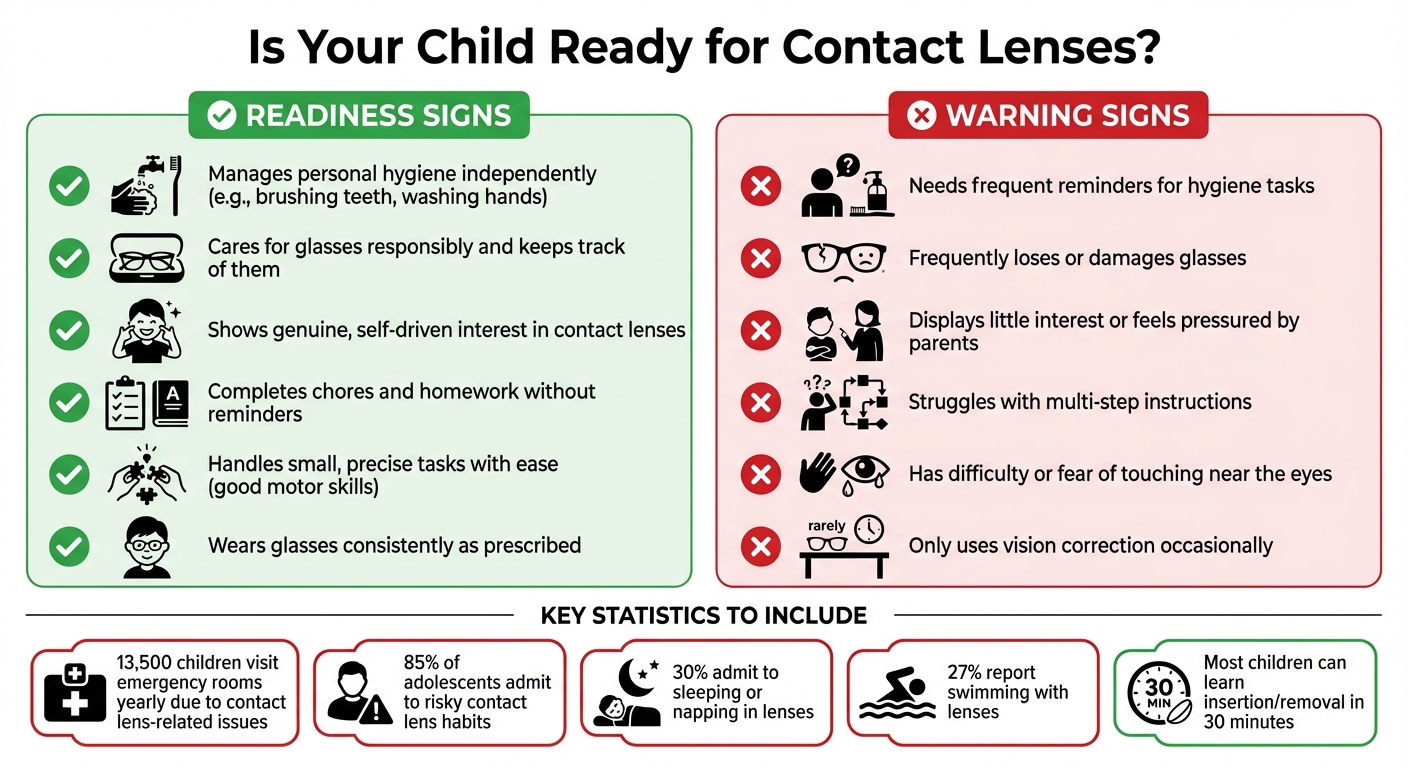
Contact Lens Readiness Signs vs Warning Signs for Children
Just because your child is interested in contact lenses doesn’t mean they’re ready. Overlooking warning signs can have serious consequences – every year, about 13,500 children end up in emergency rooms due to contact lens–related problems. Here are some key indicators that your child might not be prepared.
Hygiene issues are a major concern. If your child often needs reminders to maintain basic hygiene, they might not be ready for the strict routines that contact lenses require. Neglecting hygiene can lead to serious corneal complications.
Beyond hygiene, immature behavior is another red flag. For example, more than 85% of adolescents who wear contact lenses admit to habits that increase their risk of infection. Around 30% admit to sleeping or napping in their lenses, while 27% report swimming with them. Dr. Serena Wang, a Pediatric Ophthalmologist, stresses the importance of responsibility:
"If your child doesn’t follow the rules, you don’t supply the contacts anymore. This shows how important it is that they follow the rules."
Another warning sign is physical hesitation. If your child is uncomfortable or fearful about touching near their eyes, they may struggle with inserting and removing lenses. This hesitation can become a safety issue, especially in emergencies. Before wearing contact lenses to school, children must be able to remove them independently.
Readiness Signs vs. Warning Signs
| Readiness Indicators | Warning Signs (Red Flags) |
|---|---|
| Manages personal hygiene independently (e.g., brushing teeth, washing hands) | Needs frequent reminders for hygiene tasks |
| Cares for glasses responsibly and keeps track of them | Frequently loses or damages glasses |
| Shows genuine, self-driven interest in contact lenses | Displays little interest or feels pressured by parents |
| Completes chores and homework without reminders | Struggles with multi-step instructions |
| Handles small, precise tasks with ease (good motor skills) | Has difficulty or fear of touching near the eyes |
| Wears glasses consistently as prescribed | Only uses vision correction occasionally |
If these warning signs are present, it’s wise to take a step back. Reassess your child’s readiness every four to six months. Dr. Sidney Weiss, an Ophthalmologist, highlights the importance of maturity:
"Children must have the cognitive ability to understand that wearing contact lenses imposes a serious responsibility to protect the health of the eye."
sbb-itb-c87b093
How to Help Your Child Start Wearing Contact Lenses
Once you’ve decided your child is ready for contact lenses, taking the right steps can make the transition much easier. Switching from glasses to contacts takes patience, practice, and guidance, but with the proper approach, your child can adjust successfully.
Start with an Eye Exam at Boulder Eye Surgeons

The first step is scheduling a thorough eye exam at Boulder Eye Surgeons. During this visit, the eye care team will assess your child’s eye health and determine if contact lenses are a good option. They’ll also help you choose the most suitable type of lenses for your child’s needs. It’s worth noting that 80% of learning is visual, so ensuring your child’s vision is properly corrected is crucial for their academic performance.
Before the appointment, take some time to discuss the responsibilities of wearing contact lenses with your child. Explain the importance of daily cleaning, proper storage, and careful handling to ensure they’re prepared for the commitment.
Practice Inserting and Removing Lenses
Learning to insert and remove lenses is a key milestone before bringing them home. Most children can pick up these skills in about 30 minutes during a professional training session. To ease the process, try the "Artificial Tears" Test: have your child practice applying lubricating eye drops daily for two weeks. This helps them get comfortable with touching their eyes.
Once they’ve had professional guidance, encourage daily practice at home. Dr. Jennifer Fogt, Clinical Associate Professor at The Ohio State University College of Optometry, highlights the importance of a positive approach:
"The key is to keep the experience positive and make the child feel fully in control, although parental supervision is important to making sure proper wear and lens care is maintained."
Start small – let your child wear their lenses for just a few hours at home to help their eyes adjust. If frustration arises, take a break and try again later.
Choose Daily Disposable Lenses
Daily disposable lenses are an excellent choice for children who are new to contacts. These lenses are discarded after a single use, which simplifies care and significantly lowers the risk of infections. A six-year study involving children aged 8–12 found no serious contact lens-related adverse events, with an extremely low incidence rate of 0.61% for corneal infiltrative events.
Dr. Jason R. Miller explains why daily disposables are a game-changer:
"Daily disposables have made that conversation [about when to start] much easier to have… This technology allows improved convenience and the health benefits of wearing a new contact lens every day."
Although daily lenses may have a higher initial cost, they eliminate the need for cleaning solutions, which can save money over time. Keep a backup pair of glasses and spare lenses handy, as daily lenses are thinner and may tear more easily.
Establish a Daily Care Routine
Creating consistent habits from the start is essential. Teach your child to always wash and dry their hands before handling lenses. Make it clear that lenses should never be worn while swimming, showering, or bathing, as water can expose the eyes to harmful bacteria.
Set clear rules and consequences to reinforce responsibility. Dr. Serena Wang, a Pediatric Ophthalmologist at Children’s Health, offers this advice:
"If your child doesn’t follow the rules, you don’t supply the contacts anymore. This shows how important it is that they follow the rules."
Supervise your child’s insertion and removal routine until they feel confident doing it on their own. Teach them how to handle common issues like lens dislocation or eye irritation. To keep the process enjoyable, consider using small rewards that align with your child’s interests to encourage good habits.
Conclusion
Deciding if your child is ready for contact lenses comes down to assessing their maturity, motivation, and sense of responsibility. Factors like good hygiene, careful handling of glasses, genuine interest in wearing lenses, and fine motor skills are more important than age alone. In fact, maturity plays the biggest role in ensuring successful contact lens use.
Be mindful of warning signs, such as frequent misplacement of glasses or needing constant reminders about hygiene. As Tiffany Yanase Park, OD, advises, it’s helpful to frame the conversation as “not yet” to encourage improvement. Revisit the topic every 4–6 months to reassess readiness.
Once you’ve considered these factors, the next step is scheduling a comprehensive eye exam. This will help evaluate your child’s eye health and identify the most suitable lens options. For beginners, daily disposable lenses are a great choice since they reduce the risk of infection. Establishing a consistent care routine right from the start will set your child up for success.
Switching to contact lenses can enhance your child’s confidence, make activities like sports more convenient, and simplify their daily vision correction routine. With the right guidance and supervision, most kids adapt to lenses quickly and easily.
For expert advice and a detailed evaluation, book an appointment with Boulder Eye Surgeons. Their team is dedicated to ensuring your child’s eye care supports their long-term vision health.
FAQs
How do I know if my child is ready for contact lenses?
Most kids can start wearing contact lenses as early as 8 years old, but the real deciding factor is their maturity and ability to handle responsibility. If your child practices good hygiene, follows directions well, and takes care of their belongings, they might be ready to manage contact lenses.
Before making the switch, it’s crucial to consult an eye care professional. They can evaluate your child’s eye health and determine if contacts are a suitable option. For expert advice and care, you can reach out to Boulder Eye Surgeons, where they provide dedicated services for patients of all ages.
How do I know if my child is ready for contact lenses?
Determining if your child is ready for contact lenses means looking at their maturity level, hygiene habits, and sense of responsibility. Pay attention to how they handle daily tasks – do they wash their hands regularly, brush their teeth without constant reminders, and keep their belongings tidy? These small habits can give you a good idea of whether they’re capable of managing the cleaning and care routine that contact lenses require.
You might also want to test their fine motor skills with simple activities, like handling a small object carefully. This can help you gauge whether they can manage the delicate process of inserting and removing lenses. It’s also important to have an open conversation with your child about the responsibilities that come with wearing contacts. Make sure they understand the importance of keeping lenses clean, avoiding touching their eyes with dirty hands, and recognizing when to speak up about discomfort or redness. If they show a genuine interest in wearing contacts for practical reasons (and not just because their friends have them), that’s another positive sign they might be ready.
When you visit Boulder Eye Surgeons, their team can assess your child’s eye health and readiness for contact lenses. They’ll look at factors like your child’s hygiene habits, motivation, and dexterity to make sure they’re ready to make the switch from glasses to contacts safely.
What makes daily disposable contact lenses a good choice for kids?
Daily disposable contact lenses are an excellent choice for kids, primarily because they’re simple and hassle-free. Since there’s no need for cleaning or storing, these lenses make life easier for young users and their parents. They’re also more hygienic, as a fresh pair is used every day, which helps lower the chance of eye infections. For kids involved in sports or those dealing with allergies, these lenses offer clear and comfortable vision without the added worry of upkeep. Plus, they let children enjoy the freedom of going glasses-free while ensuring their eyes stay healthy and protected.