By age 65, 1 in 3 adults faces some form of vision loss or eye disease. Conditions like glaucoma, cataracts, macular degeneration, and diabetic retinopathy often develop silently, making regular eye exams essential. These screenings not only detect eye issues early but can also reveal broader health concerns like diabetes or high blood pressure.
Key Takeaways:
- Common Conditions: Cataracts (cloudy vision), glaucoma (peripheral vision loss), AMD (central vision issues), and diabetic retinopathy (patchy vision).
- Tests You’ll Need: Vision clarity tests, eye pressure checks, retinal imaging, and OCT scans.
- Frequency: Annual exams for most seniors; every 6–12 months for those at higher risk (e.g., diabetes, family history).
- Preparation Tips: Bring glasses, medical history, and arrange transportation if dilation is involved.
Stay ahead of potential vision problems. Early detection through routine screenings can preserve your sight and overall health.
Protecting Your Vision as You Age
sbb-itb-c87b093
Age-Related Eye Conditions Detected Through Screening
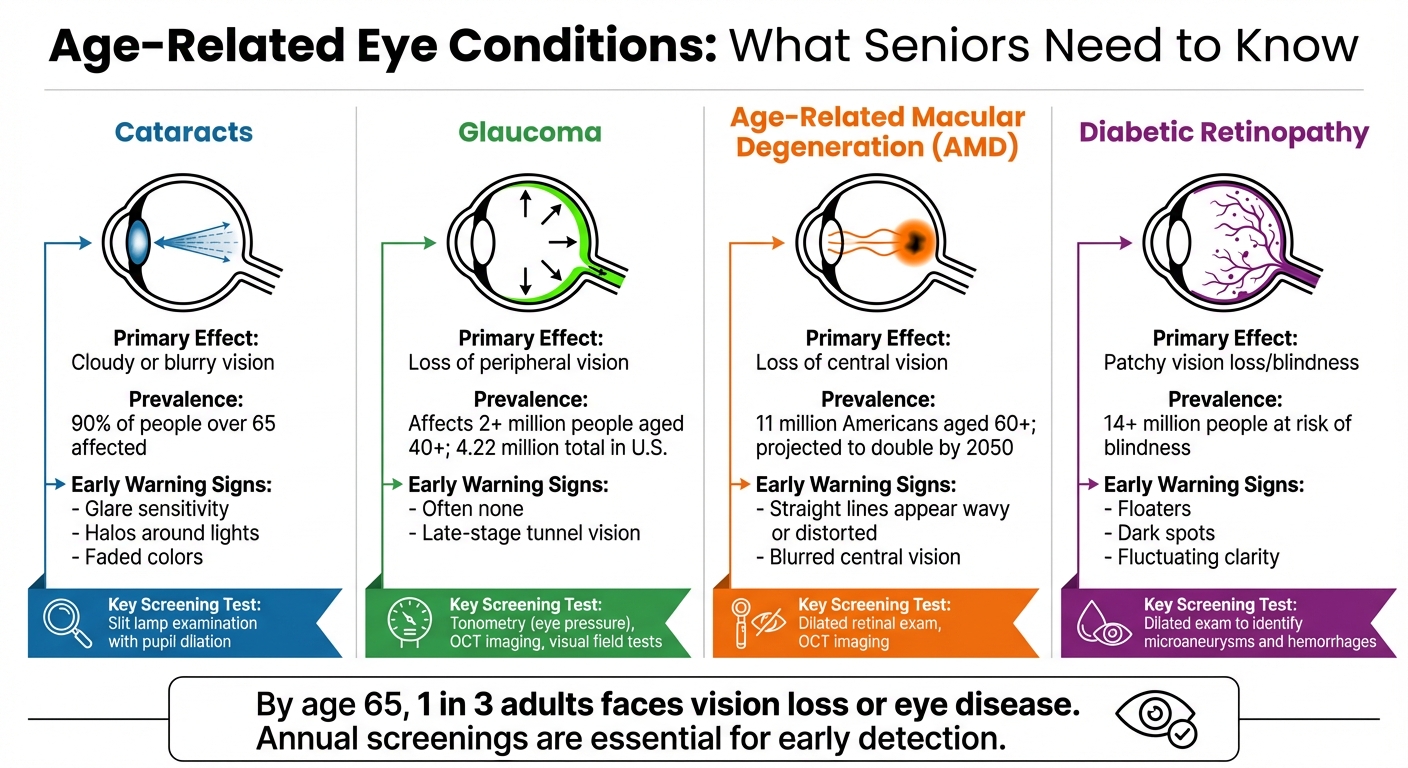
Four Major Age-Related Eye Conditions: Symptoms and Warning Signs
Regular eye screenings play a critical role in identifying four major conditions that can significantly impact vision in older adults. Each condition affects the eyes differently, and early detection through targeted tests can make a big difference in managing or slowing their progression.
Cataracts
Cataracts occur when proteins in the eye’s natural lens break down and clump together, creating cloudy areas that block light. This process often begins around age 40, though symptoms may not appear until much later. Common signs include blurry vision, faded colors, and increased sensitivity to glare. By age 80, more than half of Americans are affected, with incidence rates climbing to nearly 90% in those over 65. Eye screenings for cataracts involve a slit lamp examination and pupil dilation, allowing doctors to check for clouding, opacities, or other lens changes.
Glaucoma
Glaucoma is a silent condition that damages the optic nerve, often due to increased fluid pressure inside the eye. It affects over 2 million people aged 40 and older and progresses without noticeable symptoms until significant vision loss occurs. Peripheral vision gradually narrows, and late-stage glaucoma may lead to tunnel vision. Screenings for glaucoma include tonometry to measure eye pressure, OCT imaging to assess the optic nerve, and visual field tests to detect vision loss. Those with diabetes, high blood pressure, or a family history of glaucoma have a higher risk and should undergo regular monitoring.
Age-Related Macular Degeneration (AMD)
AMD primarily affects central vision, making tasks like reading, recognizing faces, or driving increasingly difficult. The condition damages the macula, the part of the retina responsible for sharp, detailed vision. Early symptoms may include blurred or distorted central vision, and straight lines might appear wavy – a key warning sign. Currently, 11 million Americans aged 60 and older are affected, and this number is projected to double by 2050. During screenings, doctors use dilated retinal exams to assess macular health and OCT imaging to check for tissue thinning or abnormal blood vessel growth.
Diabetic Retinopathy
Diabetic retinopathy targets the retina’s blood vessels, often as a complication of diabetes. High blood sugar can damage these tiny vessels, causing fluid leakage or bleeding. Over 14 million people are at risk of blindness from this condition if it isn’t caught early. Symptoms may include floaters, dark spots, or fluctuating vision clarity. Screenings involve dilated exams to identify microaneurysms, hemorrhages, swelling, or leaking vessels before permanent damage occurs. For anyone with diabetes, annual eye screenings are essential, even if no vision issues are noticeable.
| Condition | Primary Effect on Vision | Early Warning Signs |
|---|---|---|
| Cataracts | Cloudy or blurry vision | Glare, halos around lights, faded colors |
| Glaucoma | Loss of peripheral vision | Often none; late-stage tunnel vision |
| AMD | Loss of central vision | Straight lines appear wavy or distorted |
| Diabetic Retinopathy | Patchy vision loss/blindness | Floaters, dark spots, fluctuating clarity |
Standard Eye Screening Tests for Seniors
A thorough eye exam for seniors includes a variety of tests, each designed to assess different aspects of eye health. Together, these tests provide a detailed understanding of your vision and help detect issues before symptoms become noticeable. Most exams take between 45 and 90 minutes. Below, we outline the recommended tests and schedules based on individual risk factors.
Visual Acuity and Refraction Testing
Visual acuity testing measures how well you can see at a distance using a Snellen chart – the familiar eye chart with rows of letters that get smaller as you move down. Positioned 20 feet away, this test helps identify refractive errors and conditions like cataracts. For example, a result of 20/40 means that at 20 feet, you see what someone with normal vision sees at 40 feet.
Refraction testing, on the other hand, determines the exact prescription for corrective lenses. During this test, you’ll look through a phoropter or an automated autorefractor to refine your prescription. This step is especially useful for diagnosing presbyopia, the difficulty focusing on close objects that commonly develops between ages 41 and 60.
These tests form the foundation of any eye exam, but additional evaluations are necessary to ensure your overall eye health.
Intraocular Pressure (IOP) Measurement
To screen for glaucoma, tonometry measures the pressure inside your eye. This test involves either a puff of air or a gentle probe (after applying numbing drops) to assess intraocular pressure. Elevated pressure is a significant risk factor for glaucoma, a condition that often progresses silently until irreversible damage occurs. This quick and painless test is therefore vital for early detection.
Dilated Fundus Examination and Retinal Imaging
Dilating your pupils with special eye drops allows your doctor to examine the internal structures of your eye, including the retina, optic nerve, and blood vessels. This method is crucial for identifying early signs of diabetic retinopathy and age-related macular degeneration (AMD).
Digital retinal imaging complements dilation by capturing detailed photographs of the back of your eye. These high-resolution images create a permanent record, making it easier to monitor subtle changes over time. This is especially helpful for tracking conditions like macular degeneration.
Optical Coherence Tomography (OCT)
OCT uses light waves to produce detailed cross-sectional images of the retina, allowing your doctor to see its individual layers and measure their thickness. This non-invasive test is particularly effective for detecting macular edema, AMD, and glaucoma, as it reveals structural changes and fluid buildup that might go unnoticed during a standard exam. However, OCT may cost an additional $45 and isn’t always covered by insurance.
These advanced imaging techniques help establish a baseline for your eye health and determine how often follow-up screenings are needed.
| Test Type | What It Detects | Key Application |
|---|---|---|
| Visual Acuity | Clarity of distance vision | Diagnose myopia, hyperopia, cataracts |
| Refraction | Corrective lens needs | Determine prescription for glasses/contacts |
| Tonometry | Internal eye pressure (IOP) | Screen for glaucoma |
| Dilated Exam | Retina and optic nerve health | Detect AMD, diabetic retinopathy, nerve damage |
| OCT | Retinal layer structure | Identify macular edema, AMD, glaucoma progression |
Recommended Screening Frequency for Seniors
Screening Schedule for Healthy Seniors
For seniors aged 65 and older without major risk factors, scheduling a comprehensive eye exam once a year is highly recommended. This guidance, supported by leading eye health organizations, highlights how many age-related conditions can develop quietly without noticeable symptoms. In fact, studies show that nearly 58% of individuals with no symptoms still exhibit eye changes during routine exams that require attention, like prescription updates or disease management.
The American Optometric Association emphasizes annual exams for all adults starting at age 18, regardless of risk level, to catch potential issues before they escalate. Dr. Ronald Benner, President of the American Optometric Association, underscores this importance:
"Comprehensive eye exams provide the opportunity for early detection of eye health and visual performance problems, as well as the prevention of vision loss."
This yearly schedule becomes even more critical with age. By 80, over half of Americans either have cataracts or have undergone cataract surgery. Regular exams allow doctors to monitor subtle changes and address problems early, reducing the risk of permanent vision loss.
For seniors with specific risk factors, the screening frequency needs to be adjusted.
Screening Schedule for High-Risk Patients
Seniors considered high-risk – those with conditions like diabetes, hypertension, a family history of glaucoma or age-related macular degeneration (AMD), previous eye injuries or surgeries, or long-term corticosteroid use – should undergo exams every 6 to 12 months. For example, African Americans over 40 are 4 to 5 times more likely to develop glaucoma compared to other groups. Alarmingly, glaucoma affects an estimated 4.22 million people in the U.S., with nearly half unaware they have it. Closer monitoring for high-risk individuals ensures timely intervention to prevent vision loss. Dr. Beth Irving from the University of Waterloo emphasizes:
"The thing about most diseases, eye diseases as well, is that the longer you leave them, the harder they are to treat and the likelihood of good outcomes decreases. If you don’t have regular exams, you miss that stuff."
Additionally, if you notice sudden vision changes, floaters, flashes, or experience eye pain, it’s essential to seek immediate care. To support high-risk seniors, Medicare provides annual glaucoma screenings, making this vital care more accessible.
How to Prepare for Your Eye Screening at Boulder Eye Surgeons
Getting ready for your eye screening is essential for a smooth and effective visit. Taking a few simple steps beforehand can help ensure your experience at Boulder Eye Surgeons is both comfortable and efficient.
What to Bring to Your Appointment
Make sure to have these items with you to streamline your exam:
- Current insurance cards and a photo ID: These are necessary for processing your visit.
- All eyeglasses and contact lens details: Bring your distance, reading, and computer glasses, along with any contact lens packaging or prescription information.
- A complete list of medications: Include dosages for all medications and supplements you’re taking.
- Medical history information: Be ready to share details about chronic conditions like diabetes, high blood pressure, or high cholesterol, as well as any family history of eye diseases such as glaucoma or AMD (age-related macular degeneration).
- Notes on vision changes: If you’ve noticed issues like difficulty reading road signs, trouble seeing in dim light, or increased sensitivity to glare, jot them down to share with your doctor.
Planning for Dilated Eye Exams
If your appointment includes dilation, it’s important to prepare for temporary blurred vision and sensitivity to light. Arrange for someone to drive you home, and don’t forget to bring sunglasses for added comfort. For those undergoing specific tests, like pre-operative cataract evaluations, you’ll need to stop wearing contact lenses at least two weeks before your visit. This allows your cornea to return to its natural shape, ensuring accurate measurements.
What Happens During Your Visit
Here’s a quick look at what you can expect during your appointment. Your visit will begin with preliminary tests conducted by a technician, who will also explain the results. As one patient, Gayle E., shared:
"The technician that gave the eye exam was very friendly and explained exactly what was going on behind these blue peepers regarding my far sightedness!"
Afterward, you’ll meet with an ophthalmologist – such as Dr. Keller, Dr. Nichols, or Dr. Cuevas – for an in-depth examination and consultation. Patients often praise the doctors for their ability to make complex information easy to understand. Christine N., for example, noted:
"Dr. Cuevas explains things in easy to understand terms and is never condescending. He makes you feel secure in his knowledge"
With a 97% referral rate, Boulder Eye Surgeons is known for its focus on both clinical expertise and clear communication. The team works efficiently to keep wait times short, and their on-site optical department is ready to assist you right after your exam.
Conclusion
Eye exams are more than just a routine check – they’re a vital step in protecting your vision and overall well-being.
By age 65, about 1 in 3 older adults experiences some form of vision loss or eye disease. Many of these conditions, like glaucoma and macular degeneration, develop quietly, showing no symptoms until significant damage has occurred. Comprehensive eye exams can catch these issues early, allowing for effective management before they lead to irreversible harm.
Take glaucoma, for example: millions live with undiagnosed glaucoma, and nearly half don’t even realize they have it. But these exams do more than just preserve eyesight. They can also reveal early warning signs of systemic health problems, such as diabetes, high blood pressure, heart disease, and even brain tumors. By examining the blood vessels and nerves in your eyes, doctors can detect these issues early, making treatment more effective and less costly than addressing advanced complications.
At Boulder Eye Surgeons, board-certified ophthalmologists use advanced OCT technology to identify problems before symptoms arise. Whether you require screenings every 1–2 years or more frequent monitoring due to conditions like diabetes or a family history of eye disease, their thorough approach is designed to help maintain both your vision and your independence.
Don’t wait for symptoms to appear. Schedule your comprehensive eye screening with Boulder Eye Surgeons today and take charge of your eye health for a brighter future.
FAQs
Do I really need an eye exam if my vision seems fine?
Regular eye exams are essential, even if your vision feels perfect. Many eye conditions, like glaucoma or macular degeneration, can develop silently without obvious symptoms. A comprehensive exam is often the only way to catch these issues early. Plus, eye exams can sometimes uncover signs of broader health concerns, such as diabetes or high blood pressure, offering an extra layer of protection for your overall health.
How do I know if I’m high-risk and need exams more often?
If you’re over 65, certain factors might put you at higher risk for eye problems. These include a family history of eye diseases, diabetes, high blood pressure, or previous eye conditions. For seniors with these risks, eye exams every 6–12 months are a smart choice.
If you already have glaucoma, diabetes, or notice symptoms of an eye condition, it’s essential to consult your eye care provider for personalized guidance. Regular eye exams are key to catching problems early – often before you even notice any symptoms.
Will my eye exam include OCT, and is it covered by insurance?
Your eye exam might involve an OCT scan (Optical Coherence Tomography). Whether this is covered by insurance depends on your specific plan. Some insurance plans include OCT scans as part of routine eye exams, while others may not. It’s a good idea to check with your insurance provider to understand your coverage details.